
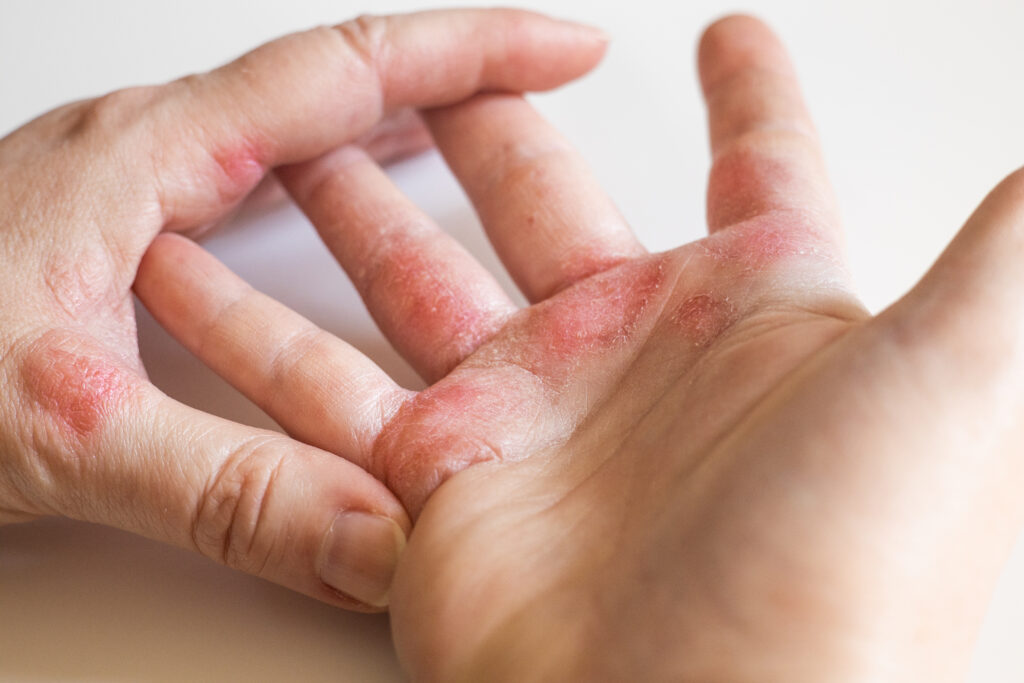
When you have eczema-prone skin, choosing a moisturizer isn’t just about finding something that feels hydrating. The goal is to support your skin barrier, help keep moisture in, and minimize ingredients that may trigger irritation.
Eczema is an inflammatory skin condition associated with a compromised skin barrier and an overactive immune response. When that protective barrier isn’t working as effectively, moisture can escape more easily while irritants can get in. That’s one reason consistent moisturizing is such an important part of eczema care.
So, what should you actually look for on the ingredient label?
What Are the Best Ingredients for Eczema-Prone Skin?
Some of the best ingredients to look for in an eczema-friendly moisturizer include ceramides, petrolatum, glycerin, hyaluronic acid, dimethicone, and colloidal oatmeal.
These ingredients work in different ways. Some help attract water to the skin, while others help reduce moisture loss or support the skin’s protective barrier.
1. Ceramides: Support the Skin Barrier
Ceramides are lipids naturally found in the outer layer of your skin that help maintain its protective barrier.
For eczema-prone skin, ceramide-containing moisturizers can help support a barrier that has become dry or compromised.
Look for: Ceramides in a thick, fragrance-free cream or ointment.
2. Petrolatum: Locks In Moisture
Petrolatum helps form a protective layer over the skin that reduces moisture loss.
This can be especially helpful for very dry or eczema-prone areas. Ointments containing petrolatum tend to be thicker than lotions, which can make them useful when your skin needs more intensive moisture.
Look for: Petrolatum or petroleum jelly.
3. Glycerin: Attracts Hydration
Glycerin is a humectant, meaning it helps attract and hold water in the skin.
You’ll often find it in moisturizers designed for dry or sensitive skin.
Look for: Glycerin in a fragrance-free cream or moisturizer.
4. Hyaluronic Acid: Helps Skin Hold Water
Hyaluronic acid helps attract and retain water in the skin.
But don’t choose a product based on hyaluronic acid alone. With eczema-prone skin, the entire formula matters.
A simple, fragrance-free moisturizer containing hyaluronic acid may be a better choice than a complex serum containing several potentially irritating ingredients.
5. Dimethicone: Adds a Protective Layer
Dimethicone is a skin protectant that can help reduce moisture loss while creating a barrier between your skin and the environment.
It’s commonly found in barrier creams and moisturizers made for dry or sensitive skin.
6. Colloidal Oatmeal: Helps Soothe Dry, Itchy Skin
Colloidal oatmeal is commonly used to help soothe and protect dry, itchy, irritated skin.
You may find it in moisturizers, creams, and bath products formulated specifically for eczema-prone or sensitive skin.
What Should You Avoid if You Have Eczema-Prone Skin?
Sometimes the most important part of the ingredient list is what isn’t there.
Fragrance
Choose products labeled fragrance-free whenever possible.
Fragranced soaps, moisturizers, and laundry products can be irritating for eczema-prone skin.
And remember: “unscented” and “fragrance-free” aren’t necessarily the same thing.
Harsh Cleansers
Cleansing shouldn’t leave your skin feeling tight or stripped.
Gentle, fragrance-free or soap-free cleansers are generally better suited for eczema-prone skin. Soap-free synthetic detergents, also called syndets, can be an alternative to harsher soaps.
Too Many Active Ingredients
More skincare isn’t always better, especially during an eczema flare.
If your skin is already dry, itchy, or inflamed, introducing multiple exfoliating acids, retinoids, or other potentially irritating actives may make symptoms worse.
A dermatologist can help you determine which products make sense for your skin and when it’s safe to use them.
Is a Cream or Lotion Better for Eczema?
For eczema-prone skin, a thick cream or ointment is generally preferred over a lightweight lotion.
Why? Thicker moisturizers are better at helping trap water in the skin.
An easy way to think about texture is:
Ointment → Cream → Lotion or Thicker → Lighter
If an ointment feels too heavy for everyday use, a fragrance-free cream may be a more comfortable option you’ll use consistently.
When Should You Moisturize Eczema-Prone Skin?
One of the best times to moisturize is immediately after bathing, while your skin is still slightly damp.
At Skin Solutions Dermatology, we recommend remembering the 3-minute rule: apply a thick, fragrance-free moisturizer within about three minutes of getting out of a lukewarm bath or shower to help trap moisture in your skin.
A simple routine looks like this:
Keep the water lukewarm. Very hot water can contribute to dryness.
Cleanse gently. Use a mild, fragrance-free cleanser.
Pat, don’t scrub, your skin dry.
Moisturize within three minutes. Apply your cream or ointment while your skin still has some moisture.
Does “Natural” Mean Better for Eczema?
No. “Natural” doesn’t automatically mean eczema-friendly.
Plant extracts, essential oils, fragrances, and other botanical ingredients can still irritate sensitive skin.
Instead of choosing a product because it says natural or clean on the front, pay attention to the actual ingredient list.
For eczema-prone skin, simple, gentle, fragrance-free formulas are often the better place to start.
Can Moisturizer Prevent Eczema Flare-Ups?
Consistent moisturizing can help support the skin barrier and is an important part of managing eczema, but moisturizer alone can’t prevent every flare.
Eczema can be influenced by your immune system, genetics, environment, allergens, irritants, stress, and other triggers. Different forms of eczema can also have different causes.
That’s why skincare is only one piece of eczema management.
If your symptoms keep returning despite consistent moisturizing, there may be more going on than dry skin.
When Is Moisturizer Not Enough for Eczema?
If your eczema continues to flare despite consistent skincare, it may be time to see a dermatology provider.
Consider scheduling an evaluation if:
- Your rash repeatedly returns after over-the-counter treatment
- Itching interferes with sleep or daily life
- Your skin becomes painful, cracked, or severely inflamed
- You notice pus, warmth, or yellow or honey-colored crusting
- You’re unsure whether the rash is actually eczema
Different types of eczema, including atopic dermatitis, contact dermatitis, seborrheic dermatitis, nummular eczema, and dyshidrotic eczema, can require different approaches.
A professional evaluation can help identify what you’re dealing with and guide an appropriate treatment plan.
Learn more about eczema causes, symptoms, and treatment in our Patient’s Guide to Eczema.
What Should You Look for in an Eczema Moisturizer?
You don’t need the longest ingredient list.
For eczema-prone skin, start with a thick, fragrance-free cream or ointment and look for ingredients that hydrate and support the skin barrier, such as:
Ceramides
Petrolatum
Glycerin
Hyaluronic Acid
Dimethicone
Colloidal Oatmeal
Then focus on consistency. Moisturize regularly, use gentle cleansers, avoid known irritants, and apply moisturizer shortly after bathing.
And if your skin continues to flare despite doing everything “right,” don’t assume you just need a stronger moisturizer. A dermatology provider can help determine what’s triggering your symptoms and whether additional treatment is needed.
Schedule an appointment with Skin Solutions Dermatology to get personalized guidance for your ski
Frequently Asked Questions About Eczema-Prone Skin
What is the best ingredient for eczema?
There isn’t one ingredient that’s best for everyone. Ceramides, petrolatum, glycerin, hyaluronic acid, dimethicone, and colloidal oatmeal can all play different roles in hydrating, protecting, or soothing eczema-prone skin.
Are ceramides good for eczema?
Ceramides help support the skin’s protective barrier and can be useful in moisturizers for dry, eczema-prone skin.
Is hyaluronic acid good for eczema?
Hyaluronic acid can help attract and retain water in the skin. However, the overall product matters, so choose a gentle, fragrance-free formulation rather than focusing on hyaluronic acid alone.
Is petroleum jelly good for eczema?
Petroleum jelly can help reduce moisture loss and protect very dry skin. Thick ointments can be particularly helpful when the skin is very dry or the barrier is compromised.
Should you moisturize eczema every day?
Consistent moisturizing is an important part of eczema management. Apply moisturizer regularly and especially after bathing to help support your skin barrier.
What’s the difference between eczema and dry skin?
Dry skin can feel rough, tight, or flaky, while eczema is an inflammatory skin condition that can cause itching and a symptomatic rash. Because eczema can look different depending on the type and skin tone, persistent or recurring symptoms should be evaluated by a dermatology provider.
Can the wrong skincare products make eczema worse?
Yes. Fragrances, harsh cleansers, irritants, or products that don’t agree with your skin may contribute to irritation. Identifying and avoiding individual triggers can be an important part of managing recurring symptoms.
When should I see a dermatologist for eczema?
See a dermatology provider when eczema keeps returning, over-the-counter care isn’t controlling your symptoms, itching disrupts your sleep or daily life, or you develop possible signs of infection such as warmth, pus, or yellowish crusting.
TEST YOUR KNOWLEDGE
How Eczema-Friendly Is Your Skincare Routine?
Think you know what eczema-prone skin needs? Test your knowledge of moisturizer ingredients, product labels, and skin-barrier care with our quick 3-question quiz.