
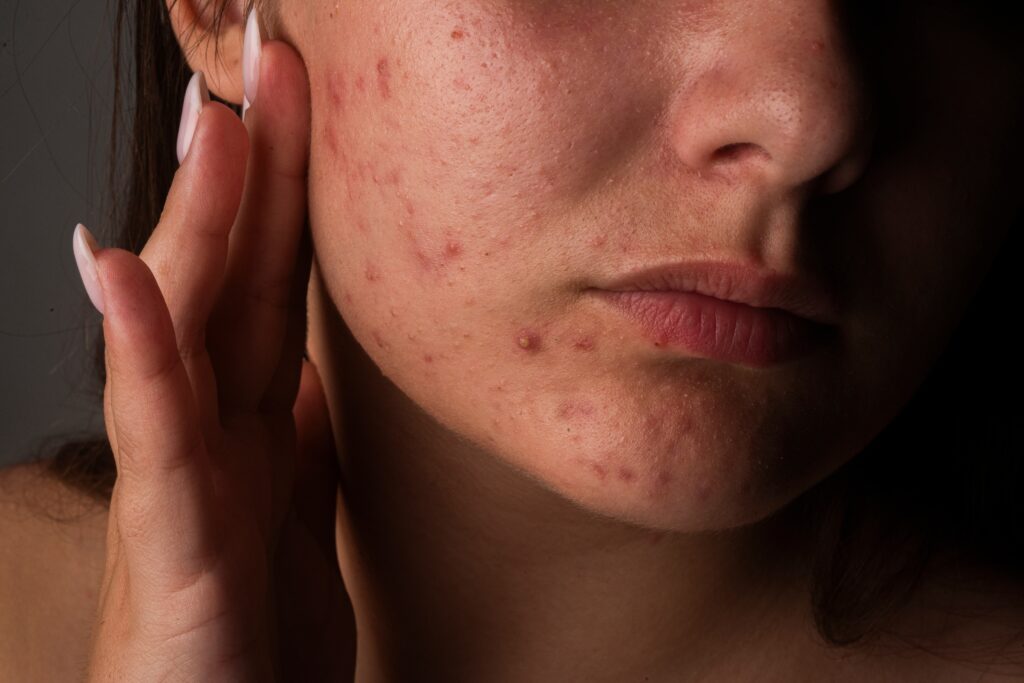
You started taking a new vitamin, protein powder, or wellness supplement — and suddenly, you’re breaking out.
Could your supplement be the reason?
Possibly. Certain dietary supplements have been associated with acne or acne-like breakouts in some people. Ingredients that have been reported in connection with breakouts include vitamins B6 and B12, iodine, whey protein, and some muscle-building supplements.
That doesn’t mean you should immediately stop everything you’re taking. But if your acne appeared or noticeably worsened after starting a new supplement, checking the label may be a useful next step.
Here’s what to look for.
Can Supplements Cause Acne?
Yes, certain supplements may trigger or worsen acne or acne-like eruptions in some people.
The connection isn’t the same for every supplement — or every person. Your hormones, skin type, dosage, other medications, and the reason you’re taking a supplement can all matter.
That’s why the timing of your breakout can provide an important clue.
Ask yourself:
Did I recently start a new vitamin or supplement?
Did my dosage change?
Did I start a new protein or workout supplement?
Did the breakout begin shortly afterward?
Is my usual acne routine suddenly not working?
If you answered yes to one or more, take another look at what you’re taking.
Which Supplements May Be Linked to Breakouts?
1. Vitamin B12
High-dose vitamin B12 has been reported to cause acne-like eruptions in some people.
This doesn’t mean everyone taking B12 will break out. Vitamin B12 is an important nutrient, and supplementation may be medically necessary for people with a deficiency or certain health conditions.
The important question isn’t simply, “Is B12 bad for my skin?”
It’s why you’re taking it, how much you’re taking, and whether your skin changed after you started.
If your doctor prescribed B12, talk with them before making any changes.
2. Vitamin B6
Vitamin B6 has also been reported in connection with acne-like eruptions, particularly with higher-dose supplementation.
Check more than bottles labeled “Vitamin B6.” B vitamins are frequently combined in B-complex vitamins, multivitamins, energy products, and other supplements.
That makes the Supplement Facts label especially important.
3. Iodine and Kelp Supplements
Taking an iodine or kelp supplement?
Iodine-containing supplements have also been associated with acne-like breakouts.
Kelp and other seaweed-derived supplements can contain iodine, so the ingredient may not always be obvious from the product name alone.
Again, the goal isn’t to eliminate iodine from your diet. Your body needs iodine for normal thyroid function.
Instead, consider whether a concentrated supplement could be relevant if you notice a new or unusual breakout after starting one.
4. Whey Protein
If your breakouts appeared around the same time you started drinking protein shakes, look at the type of protein you’re using.
Whey protein has been associated with acne in several reports and observational studies, particularly among adolescents and young adults using it for exercise or muscle building.
However, the research isn’t completely settled. A randomized controlled trial in young men with acne did not find worsening acne severity with whey compared with a non-whey supplement.
So whey protein isn’t automatically the cause of every gym-related breakout.
But if you notice a clear pattern between starting whey and developing new acne — particularly on the face, chest, shoulders, or back — mention it to your dermatologist.
5. Muscle-Building Supplements
Be particularly careful with supplements marketed for rapid muscle growth, bodybuilding, or dramatic performance enhancement.
Some muscle-building supplements have been associated with acne, and certain products may contain ingredients that aren’t obvious from their marketing.
If you’re experiencing sudden, severe, or widespread acne after beginning a new workout supplement, bring the actual product or a photo of its ingredient label to your dermatology appointment.
What About Biotin? Does Biotin Cause Acne?
The relationship between biotin and acne isn’t as clear as social media sometimes makes it sound.
Biotin is commonly marketed for healthier hair, skin, and nails, but that doesn’t mean everyone needs to supplement it — or that it is proven to cause acne in everyone who takes it.
There’s another reason your healthcare providers should know you’re taking it: biotin can interfere with certain laboratory tests.
Rather than automatically blaming biotin for a breakout, look at your complete supplement routine and discuss any concerns with your healthcare provider.
How Can You Tell If a Supplement Is Breaking You Out?
There isn’t an at-home test that can definitively tell you, “This vitamin caused my acne.”
Instead, look for a pattern.
Start with the timeline.
Think about when your skin changed.
What did you add before the breakout started?
It may be a new:
Multivitamin
Hair, skin, and nail supplement
B-complex vitamin
Protein powder
Pre-workout
Energy supplement
Kelp or iodine supplement
Muscle-building product
Sometimes the most helpful clue isn’t another skincare product.
It’s the ingredient label.
Should You Stop Taking a Supplement If You’re Breaking Out?
Don’t automatically stop a medically necessary or prescribed supplement because you’re experiencing acne.
If a healthcare professional recommended the supplement to treat a deficiency or medical condition, talk with them first.
For non-prescribed supplements, review what you’re taking, why you’re taking it, and the dosage.
And remember: “natural” doesn’t automatically mean risk-free.
Supplements can cause side effects, interact with medications, and contain doses that may be much higher than what you’d receive through your diet.
What Should You Do If You Think Your Supplements Are Causing Acne?
Instead of changing your entire skincare routine at once, start with these three steps.
1. Make a List
Write down every vitamin, powder, gummy, shake, pre-workout, and supplement you’re currently taking.
Don’t forget products you only use a few times a week.
2. Check the Ingredient Labels
Look for overlapping ingredients.
You may discover, for example, that your multivitamin, energy supplement, and hair supplement all contain some of the same vitamins.
Bring the labels with you if you schedule a dermatology appointment.
3. Look at the Timing
When did you start the supplement?
When did the breakout begin?
A timeline can help your dermatologist evaluate whether a supplement may be contributing or whether something else is more likely to be causing your acne.
What If You Stop a Supplement and You’re Still Breaking Out?
Your supplement may not be the only factor.
Acne can be influenced by multiple factors, and breakouts may continue even after you’ve changed something in your routine.
You could also be dealing with a different condition that resembles acne.
That’s why persistent breakouts deserve a closer look rather than an endless cycle of eliminating foods, supplements, and skincare products.
When Should You See a Dermatologist About Your Breakouts?
Consider scheduling an appointment if:
Your acne appeared suddenly after starting a new supplement
Your breakouts are painful, deep, or widespread
You’re developing acne on your chest or back
Your acne is leaving dark spots or scars
You’ve tried over-the-counter acne treatment without improvement
You’re unsure whether your bumps are actually acne
You take medically necessary supplements and don’t know what you can safely change
A dermatologist can look at your skin, medications, supplements, and breakout pattern together rather than treating each piece separately.
Frequently Asked Questions About Supplements and Acne
Can vitamins make you break out?
Certain vitamins and dietary supplements have been associated with acne or acne-like eruptions in some people, including high-dose vitamins B6 and B12. Not everyone who takes these vitamins will develop acne.
Can vitamin B12 cause acne?
Vitamin B12 has been linked to acne-like eruptions in some people, particularly at higher supplemental doses. If B12 was prescribed for a deficiency or medical condition, talk with your healthcare provider before changing your dose.
Does whey protein cause acne?
Some studies and case reports have found an association between whey protein supplementation and acne, while other research has not found that whey worsens acne. If your breakouts began after starting whey protein, discuss the timing with your dermatologist.
Does biotin cause acne?
There isn’t strong evidence showing that biotin routinely causes acne. Biotin can, however, interfere with certain laboratory test results, so tell your healthcare providers if you’re taking it.
Can pre-workout cause acne?
It depends on what’s in it. Pre-workout and muscle-building products can contain multiple ingredients, so check the entire Supplement Facts label rather than assuming one ingredient is responsible.
Should I stop taking vitamins if I’m breaking out?
Not necessarily. Don’t discontinue a prescribed or medically necessary supplement without talking with the healthcare professional who recommended it. A dermatologist can help evaluate whether your supplement routine may be contributing to your breakouts.
Still Breaking Out? Look Beyond Your Skincare Routine.
If you’ve switched cleansers, added acne treatments, and simplified your skincare but your breakouts keep coming back, the answer may not be in your bathroom cabinet.
Take a look at what you’re taking every day.
A new vitamin, protein powder, or supplement could be one piece of the puzzle — but you don’t have to figure it out alone.
Schedule an appointment with Skin Solutions Dermatology. Bring a list or photos of your current supplements, and our dermatology team can help evaluate what’s contributing to your breakouts and build a treatment plan around your skin.
Think you know which supplements may affect your skin? Take our quick quiz to test your knowledge.