
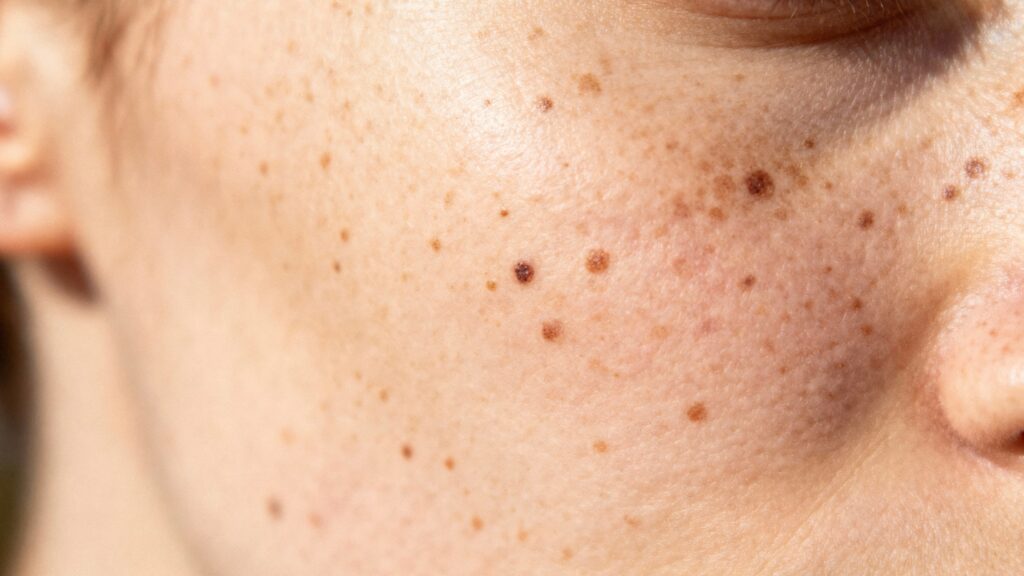
You notice a new brown spot on your face or hand. Is it a freckle, an age spot, or something that needs a closer look?
Freckles and age spots are common, but certain types of skin cancer can resemble ordinary pigmentation. Knowing when a spot deserves professional attention is an important part of protecting your skin health.
How can you tell if a brown spot might be skin cancer? Look for changes in size, shape, color, or symptoms. A spot that looks different from your others, repeatedly bleeds, or doesn’t heal should also be evaluated by a dermatologist.
Can Skin Cancer Look Like a Freckle or Age Spot?
Yes. Melanoma, including a type called lentigo maligna melanoma, can sometimes resemble an ordinary brown sun spot, particularly on areas that have experienced years of sun exposure.
The challenge is that benign pigmentation and skin cancer can share similar characteristics.
- Freckles are generally small, flat spots that may darken with sun exposure.
- Age spots are typically persistent areas of pigmentation associated with cumulative sun exposure.
- Skin cancer may appear as a new or changing spot, but its appearance can vary considerably.
Freckles and true age spots are benign. However, you cannot reliably determine whether an unfamiliar spot is harmless based on appearance alone.
Want to understand the differences between these common types of pigmentation? Read our earlier guide: Freckles vs. Age Spots: Can You Tell the Difference?.
5 Changes in a Brown Spot You Shouldn’t Ignore
1. A Spot That Suddenly Changes
A spot that’s growing, darkening, or changing shape deserves attention, especially if the change is new or unexplained.
2. A Spot That Looks Different From the Others
Sometimes called the ugly duckling sign, a spot that stands out from your other freckles or moles may need evaluation.
3. Uneven Color or Irregular Edges
Multiple colors, asymmetry, or irregular borders can be warning signs of melanoma.
Learn more about these changes in our ABCDE guide to spotting skin cancer.
4. Bleeding, Crusting, or a Sore That Won’t Heal
Not all skin cancers appear as dark spots. Some develop as persistent sores, scaly patches, or growths that repeatedly bleed or crust.
5. New Itching, Pain, or Tenderness
A new symptom in an existing spot may indicate a change worth discussing with your dermatologist.
Remember: Not every changing spot is skin cancer, and not every skin cancer shows these warning signs. A professional examination is the best way to determine whether further testing is necessary.
Should You Treat a Brown Spot Before Having It Checked?
If you’re considering a laser treatment, chemical peel, or dark spot corrector, it’s important to know what you’re treating first.
While cosmetic treatments may help improve the appearance of benign sun spots, an undiagnosed skin cancer should never be treated as ordinary hyperpigmentation.
A dermatology provider can evaluate the area and determine whether it is appropriate for cosmetic treatment or requires additional examination.
When Should You Schedule a Skin Exam?
At Skin Solutions Dermatology, we encourage annual skin cancer screenings as part of preventive skin care.
However, don’t wait for your annual appointment if you notice a suspicious or changing spot.
During a skin examination, your provider can assess areas of concern and recommend a biopsy when necessary.
Frequently Asked Questions About Age Spots & Skin Cancer
Can an age spot turn into skin cancer?
A true age spot is benign and does not turn into skin cancer. However, some skin cancers can resemble age spots, making professional evaluation important when a spot is suspicious.
Can melanoma look like a freckle?
Yes. Some melanomas may initially resemble small freckles or ordinary brown spots. Changes in appearance or symptoms are important warning signs.
Should I worry about a new brown spot on my face?
Not every new brown spot is dangerous. However, a new, changing, or unusual spot should be evaluated by a dermatology provider, particularly if it looks different from your other spots.
Can a dermatologist tell if a spot is cancerous just by looking at it?
Dermatologists can identify suspicious features through a skin examination, sometimes using a dermatoscope. If cancer is suspected, a biopsy may be necessary to confirm the diagnosis.
Can You Spot the Warning Signs?
Is that brown spot harmless or something to check? Test your knowledge of freckles, age spots, and skin cancer with this quick 3-question quiz!
Don’t Guess About That Spot. Get It Checked!
Freckles and age spots are common, but recognizing unusual changes can make an important difference in your skin health.
At Skin Solutions Dermatology, our providers offer skin cancer screenings and evaluations of suspicious moles, spots, and growths.
Whether you’ve noticed something new or are due for your annual skin check, we’re here to help.
Schedule your skin exam with Skin Solutions Dermatology today.