
Scabies is a highly contagious skin infestation caused by a microscopic, epidermal-dwelling mite known as Sarcoptes scabiei [cite: 4092, 4093, 4132]. The hallmark symptom is intense, unyielding itching that characteristically worsens at night [cite: 4085, 4086, 4133]. While the thought of a skin infestation can be distressing, scabies is highly treatable [cite: 4128]. Successful eradication and relief rely on an accurate diagnosis, a synchronized treatment routine for the entire household, and thorough environmental decontamination to prevent re-infestation [cite: 4115, 4122, 4136].
What Is Causing My Intense Itching?
Understanding the life cycle of the scabies mite is a strategic first step in managing the condition. The intense itch is not a simple surface allergy; it is a delayed hypersensitivity reaction to the proteins, eggs, and fecal pellets (scyballa) left by the female mite as she burrows directly into the upper layer of your skin [cite: 4101, 4144, 4149].
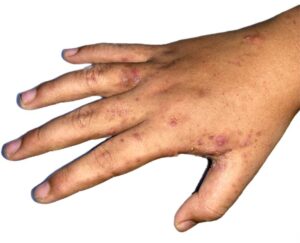
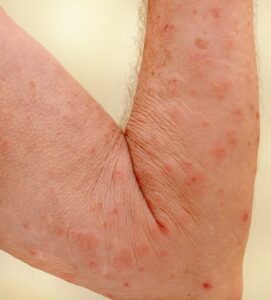
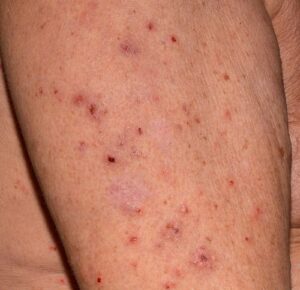

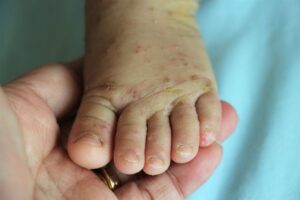
You can think of a scabies infestation as an “uninvited cellular barrier breach.” Identifying these microscopic pathways early is the essential “So What?” factor in your recovery plan [cite: 4100]. Because the mites spread rapidly through close personal contact, catching the infestation early allows you to treat your entire household immediately, cutting off the transmission chain before chronic skin damage or secondary infections take hold [cite: 4095, 4115, 4126].
Understanding the Presentation: Standard vs. Crusted Scabies
Scabies can present in different forms depending on your immune system’s baseline. Recognizing these distinct profiles helps ensure you receive the appropriate level of medical intervention [cite: 4081, 4084].
| Infestation Variant | Key Differentiators and Visual Profiles |
|---|---|
| Standard Scabies | Appearance: Scattered red (erythematous), scratched, and crusted bumps (papules), tiny blisters (vesicles), or small pus tips (pustules) [cite: 4081]. Look for small, thread-like, wavy lines embedded within the skin surface, known as linear burrows [cite: 4082, 4149]. Mite Load: Typically involves only a small number of active mites (usually 10 to 15) across the entire body. |
| Crusted (Norwegian) Scabies | Appearance: Characterized by thick, widespread, gray or yellow-colored hyperkeratotic crusts and plaques [cite: 4084, 4147]. It frequently spreads to include the scalp, face, ears, palms, and soles [cite: 4084, 4089]. It may be less itchy due to altered immune signaling [cite: 4133]. Mite Load: Highly aggressive; millions of live mites inhabit the thick crusts, making it extraordinarily contagious [cite: 4147]. |
Am I at risk for acquiring scabies?
Infestation with scabies is an everyday environmental exposure that can happen to anyone. It is completely unrelated to personal hygiene flaws, a lack of cleanliness, or your household cleaning routines [cite: 4092, 4132].
- Close Personal Contact: The primary risk factor is direct, prolonged skin-to-skin contact with an infested individual [cite: 4095]. Casual physical contact, such as a quick handshake, rarely transmits the mite.
- Congested Shared Environments: Spending time or living in crowded environments increases transmission rates. Common hotspots include healthcare facilities, nursing homes, school daycares, and institutional group settings [cite: 4097].
- Altered Immune Baselines: Individuals who are HIV-positive, undergoing cancer chemotherapy, or taking systemic immunosuppressive medications are at a significantly higher risk of developing the severe, widespread **crusted scabies** variant [cite: 4098].
- The Pediatric and Infant Template: Infants have unique vulnerability lines; they often display a widespread presentation that includes an intense blister-and-pus eruption across the palms and soles of the feet [cite: 4083, 4090].
Where and How It Appears on My Body
Scabies mites follow a very predictable anatomical “map” across the body surface, seeking out warm areas with a thin outer skin layer [cite: 4088].
- The Classic Landmark Corridor: Burrows and itchy papules group heavily between the fingers (interdigital web spaces), on the front of the wrists, and around the ankles [cite: 4082, 4088, 4142].
- Skin Folds and Hidden Zones: Check your intertriginous folds, including the armpits (axilla), the skin crease under the breasts, the belly button (umbilicus), and the beltline [cite: 4088, 4143].
- Genital Involvement: In men, scabies frequently creates highly characteristic, intensely itchy nodules on the penis and scrotum [cite: 4088].
- The Sparing Rule: In standard adult cases, the **face and scalp are completely spared** [cite: 4089]. The only exceptions to this rule are infants or patients dealing with severe crusted scabies, where the scalp lines can be heavily involved [cite: 4089].
Solutions I Can Try at Home
Because scabies is an active parasitic infestation deep within the skin layers, home care is focused entirely on executing your prescribed anti-parasitic treatment perfectly and safely disinfecting your home environment [cite: 4092, 4122].
- The Complete Household Rule: This is the single most vital step [cite: 4115]. Every single member of the household and all close physical contacts **must be treated at the exact same time**, even if they currently have zero itching or visible rash [cite: 4115]. Asymptomatic individuals can harbor mites and re-infest the family later if skipped [cite: 4115].
- Execute the Environmental Clean: Gather all clothing, underwear, sheets, pillowcases, and bath towels used during the 48 hours prior to treatment [cite: 4122]. Wash them in hot water with detergent and dry them on high heat in a hot dryer [cite: 4122]. For delicate, non-washable items, seal them tightly inside a plastic garbage bag for two full weeks; the mites cannot survive away from human skin past a few days [cite: 4122].
- Do Not Squeeze or Pick Bumps: Trying to scratch open active papules or pick off crusts will not remove the deep-seated mites [cite: 4092]. It will only break your skin barrier lines and track bacteria from your fingernails into the open sores [cite: 4126]. If you scratch, wash your hands under your nails immediately with soap and water [cite: 4158].
When Should I See a Dermatology Provider?
Scabies will not clear up on its own. Seeking professional clinical triage early is important to confirm your diagnosis through a gentle skin scraping and secure prescription-strength medical therapies [cite: 4100, 4101].
Seek Professional Help if You Notice These Warning Signs:
- Unmanaged Nighttime Itching: You or your child suffer from an intense itch that completely disrupts normal sleep patterns and has failed to improve with over-the-counter anti-itch creams [cite: 4086].
- Diagnostic Uncertainty: Your rash lacks clear linear burrows or mimics common conditions like flexural eczema or contact allergies, requiring your provider to perform a microscopic evaluation of skin cells to check for live mites, eggs, or feces [cite: 4101, 4106, 4107].
- Signs of a Secondary Infection: The scratched bumps become increasingly painful, swollen, or develop golden-colored, honeyed crusting and weeping pus [cite: 4081, 4126, 4155]. This suggests an active staphylococcal superinfection requiring clinical oral antibiotics [cite: 4126, 4155].
Frequently Asked Questions
- Q: How exactly should I apply my prescribed Permethrin 5% cream?
A: Massage the permethrin cream thoroughly into clean, dry skin over your entire body from the neck down to the soles of your feet, paying extra attention to your toe webs, fingernails, armpits, and groin creases [cite: 4114]. Leave the cream on undisturbed for 8 to 14 hours overnight, then rinse it off completely in a cool shower [cite: 4114]. You must repeat this exact process exactly one week later to catch any newly hatched eggs [cite: 4114, 4115]. This medication is safe for individuals aged two months and older [cite: 4116]. - Q: When is oral Ivermectin used, and how is it taken?
A: Systemic oral ivermectin tablets (dosed at 0.2mg/kg based on your weight) are indicated for widespread infestations, severe crusted scabies, or when topical creams are impractical [cite: 4119, 4121]. It is taken as a single oral dose, which must also be repeated exactly one week later to ensure complete eradication [cite: 4114, 4119]. Oral ivermectin is approved for use in individuals over 6 months of age [cite: 4120]. - Q: Why am I still itching so severely if the treatment killed all the mites?
A: Persistent itching after successful treatment is incredibly common and normal [cite: 4129]. It does not mean the medication failed or that you have live mites [cite: 4129]. Your skin is still clearing out the dead mite components, and the localized allergic inflammation can continue for 2 to 4 weeks [cite: 4123, 4129]. To soothe this phase, your provider will prescribe a large 454-gram jar of Triamcinolone 0.1% corticosteroid cream to apply twice daily starting 24 hours after your final anti-parasitic treatment [cite: 4123].
The long-term outlook for scabies is outstanding with prompt, comprehensive medical management and proper home coordination [cite: 4128]. Success relies on finishing your entire anti-parasitic routine, treating all contacts simultaneously, executing strict environmental cleanup, and collaborating closely with your dermatology provider to restore your skin comfort smoothly [cite: 4115, 4122, 4136].