
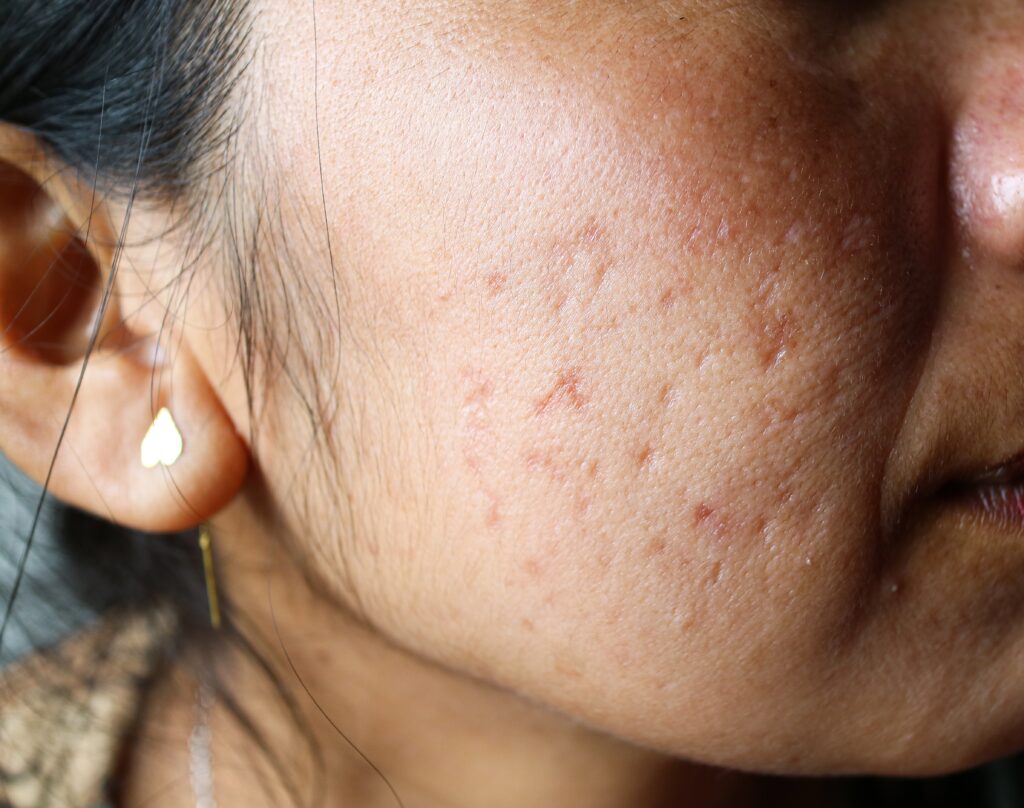
Your acne has cleared, but the scars are still there. Now what?
If you’re dealing with pitted acne scars, uneven skin texture, or indentations that won’t fade, you’ve probably researched microneedling as a possible treatment.
But there’s another question worth asking: Is traditional microneedling or RF microneedling better for your type of acne scars?
Both treatments can improve certain acne scars, but they aren’t interchangeable. The depth, shape, and severity of your scars can influence which treatment is most appropriate.
Here’s what to know before choosing.
Is RF Microneedling Better Than Traditional Microneedling for Acne Scars?
Both traditional microneedling and RF microneedling can improve the appearance of certain acne scars by stimulating collagen production. RF microneedling adds radiofrequency energy, which may provide additional benefits for skin firmness and uneven texture.
However, RF microneedling is not automatically more effective for every acne scar. The best approach depends on the type and depth of scarring, skin characteristics, and individual treatment goals.
Microneedling vs. RF Microneedling: Quick Comparison
| Traditional Microneedling | RF Microneedling | |
|---|---|---|
| How it works | Uses fine needles to stimulate collagen remodeling | Combines fine needles with radiofrequency energy |
| Acne scar concerns | Certain shallow to moderate depressed scars | Certain depressed scars that may benefit from additional collagen remodeling |
| Heat energy | No radiofrequency heat | Yes |
| Recovery | Temporary redness, swelling, and sensitivity | Temporary redness, swelling, and sensitivity; recovery varies by settings |
| Results | Gradual improvement over multiple sessions | Gradual improvement over multiple sessions |
| Best for | Patients whose scars and skin characteristics are suitable for mechanical microneedling | Patients whose scars and skin characteristics may benefit from RF-assisted treatment |
Neither option guarantees complete scar removal.
Which Treatment Works Best for Different Types of Acne Scars?
Not all acne scars are created equal.
Two people may have similar-looking acne scars but need completely different treatment approaches.
That’s why identifying your scar type is often more important than choosing a treatment based on popularity.
Before comparing treatment options, it’s also important to distinguish true acne scars from lingering discoloration. Depressed acne scars change the skin’s texture, while post-inflammatory hyperpigmentation (PIH) typically appears as flat dark marks.
Not sure which one you’re experiencing? Read our related article, Post-Acne Marks: PIH vs. Scarring & How to Get Clearer Skin.
1. Rolling Acne Scars: Can Microneedling Smooth Uneven Skin?
Rolling scars create broad depressions that give the skin a wavy or uneven appearance.
They often develop when fibrous bands beneath the skin pull the surface downward.
Which treatment may help?
Traditional microneedling and RF microneedling may improve certain rolling scars by encouraging collagen remodeling.
However, when scars are tightly tethered to deeper tissue, microneedling alone may not provide sufficient improvement.
A dermatologist may recommend subcision, a procedure that releases the fibrous bands pulling the skin downward, sometimes alongside other scar treatments.
Key takeaway: Rolling scars may require more than collagen stimulation if the skin is tethered.
2. Boxcar Acne Scars: Is RF Microneedling More Effective?
Boxcar scars are round or oval depressions with more defined edges. Some are shallow, while others extend deeper into the skin.
Which treatment may help?
Both traditional and RF microneedling may improve certain boxcar scars.
RF microneedling may be considered when additional collagen remodeling is appropriate, but evidence doesn’t establish that it is superior for every boxcar scar.
Deeper or sharply defined scars may require a combination of procedures.
Key takeaway: The depth and edges of a boxcar scar can influence treatment selection more than the treatment name alone.
3. Ice Pick Acne Scars: Will Microneedling Work?
Ice pick scars are small, narrow indentations that extend deeper into the skin.
Although they may look less noticeable than wider scars, their depth can make them challenging to treat.
Which treatment may help?
Traditional microneedling and RF microneedling are generally less effective as standalone treatments for deep ice pick scars.
A dermatologist may recommend a targeted procedure, such as TCA CROSS (chemical reconstruction of skin scars) or punch excision, depending on the individual scar.
Key takeaway: Deep ice pick scars often need a more targeted approach than microneedling alone.
When Might Traditional Microneedling Be the Better Choice?
Traditional microneedling may be appropriate for certain depressed acne scars, particularly when additional radiofrequency energy isn’t necessary.
Unlike RF microneedling, traditional microneedling stimulates collagen without delivering radiofrequency heat. The most appropriate approach depends on scar characteristics, skin tone, treatment goals, and a provider’s clinical assessment.
It may be worth discussing when:
- Your primary concern is mild to moderate uneven texture from acne scarring.
- Your scar characteristics are suitable for microneedling.
- Your clinician recommends avoiding heat-based treatment.
- You prefer to explore a non-RF option before considering other procedures.
Traditional microneedling still carries potential risks, including infection, irritation, pigmentation changes, and scarring.
Curious about the treatment process, recovery, or expected results? Explore our guide, Is Microneedling Really Worth It? Let’s Talk About the Results.
When Might RF Microneedling Be Worth Considering for Acne Scars?
RF microneedling may be worth considering for acne scars when the goal is to improve depressed scarring, uneven skin texture, and overall skin firmness. This treatment combines microneedling with radiofrequency energy to stimulate collagen and elastin production, supporting gradual improvements in the skin’s appearance.
At Skin Solutions Dermatology, we offer Scarlet RF Microneedling, a nonsurgical treatment that uses short-pulsed radiofrequency energy to support skin rejuvenation.
What Are the Benefits of Scarlet RF Microneedling?
Scarlet RF microneedling can address several cosmetic skin concerns, including:
- Acne scars: May improve the appearance of certain depressed acne scars by encouraging collagen remodeling.
- Uneven skin texture: Helps improve the appearance of rough or irregular skin.
- Enlarged pores: May reduce the appearance of visible pores.
- Fine lines and wrinkles: Supports smoother, firmer-looking skin.
- Mild skin laxity: May provide skin-tightening benefits through collagen stimulation.
While RF microneedling offers additional radiofrequency energy, it is not automatically more effective than traditional microneedling for every type of acne scar. The most appropriate treatment depends on scar depth, skin type, and individual treatment goals.
How Many Scarlet RF Treatments Are Needed for Acne Scars?
Patients with acne scars may need approximately 3–6 Scarlet RF microneedling sessions, depending on the type and severity of their scarring.
Because acne scars develop at different depths, treatment plans are individualized. Some patients may benefit from combining microneedling with other acne scar treatments.
At Skin Solutions Dermatology, our trained providers evaluate your skin and recommend a treatment plan based on your specific concerns.
How Long Does It Take to See Results From Scarlet RF Microneedling?
Scarlet RF microneedling results develop gradually as the skin produces new collagen and elastin.
Some patients may notice early improvements in skin firmness, while collagen remodeling typically develops over the following 2–3 months. Skin improvements may continue for up to six months after treatment.
Results vary depending on the severity of acne scarring, the number of treatments, and individual healing responses.
What Is the Recovery Time After Scarlet RF Microneedling?
Scarlet RF microneedling typically involves approximately 1–4 days of downtime, although recovery varies by patient and treatment intensity.
Temporary redness, sensitivity, mild swelling, or slight bruising may occur following treatment. Your provider will explain what to expect and recommend appropriate aftercare.
As with any medical aesthetic procedure, potential risks should be discussed before treatment. Proper training, individualized settings, and patient selection are important for minimizing complications.
Is Scarlet RF Microneedling Right for Your Acne Scars?
Scarlet RF may be an option for patients seeking to improve acne scars while also addressing concerns such as uneven texture, enlarged pores, or mild skin laxity.
At Skin Solutions Dermatology, our trained providers assess your skin concerns, medical history, and treatment goals to determine whether Scarlet RF microneedling, traditional microneedling, or another acne scar treatment may be most appropriate.
Does Skin Tone Affect Which Acne Scar Treatment Is Best?
Yes. Skin tone and a history of post-inflammatory hyperpigmentation can influence treatment planning.
People with more melanin-rich skin may be more susceptible to dark marks after skin inflammation or injury.
Traditional microneedling may be an option for a wide range of skin tones. RF microneedling can also be used in appropriately selected patients with darker skin tones, but the risk of pigmentation changes and other complications isn’t zero.
Your provider should evaluate your skin’s response to previous treatments, pigmentation history, and individual risk factors before recommending either procedure.
If lingering discoloration is one of your primary concerns, explore A Dermatologist’s Guide to Fading Post-Inflammatory Hyperpigmentation to learn more about managing dark spots after inflammation.
Can Microneedling Completely Remove Acne Scars?
Neither traditional microneedling nor RF microneedling can guarantee complete acne scar removal.
The goal is usually to reduce the visibility of scars and improve overall skin texture.
Some patients experience meaningful improvement, while others need additional procedures to address deeper or more complex scarring.
Results depend on the type of scars being treated, the chosen procedure, and the skin’s individual response.
A personalized consultation can help establish realistic expectations before treatment begins.
5 Questions to Ask Before Choosing an Acne Scar Treatment
Before scheduling traditional or RF microneedling, consider asking your provider:
What type of acne scars do I have? Rolling, boxcar, and ice pick scars may require different treatments.
Would traditional or RF microneedling be more appropriate for my scars? Ask what makes one option preferable for your skin.
Would I benefit from combination treatments? Some scars respond better when multiple techniques are used.
What are the risks for my skin tone and medical history? Discuss pigmentation changes, scarring, and other potential complications.
What level of improvement is realistic? Understanding expected results can help you make an informed decision.
If you’re still experiencing active breakouts, your dermatologist may recommend focusing on acne management before beginning scar treatments.
Preventing new breakouts can help reduce the risk of developing additional scars while you’re addressing existing ones.
For more information about acne treatment expectations, read Patience Is Key: When to Expect Acne Results.
Frequently Asked Questions About Damaged Skin Barriers and Sensitive Skin
Is RF microneedling better for deep acne scars?
Not necessarily. RF microneedling may improve certain depressed scars, but deep ice pick scars and tethered rolling scars may require other procedures. Scar depth and structure help determine the most appropriate treatment.
Which is better for pitted acne scars: microneedling or RF microneedling?
Both may improve certain pitted acne scars, particularly some rolling and boxcar scars. RF microneedling adds radiofrequency energy, but that doesn’t make it the best option for every patient.
Can RF microneedling make acne scars worse?
RF microneedling is designed to improve skin texture and the appearance of certain acne scars. However, results vary, and complications or unwanted changes in skin texture are possible. Choosing a qualified, experienced provider and following recommended aftercare are important ways to minimize risk.
Can you combine microneedling with other acne scar treatments?
Yes. Depending on the type of scarring, a dermatologist may recommend combining microneedling with procedures such as subcision or other targeted scar treatments. Combination plans should be individualized.
How Much Do You Know About Acne Scars? 👀
Not all acne scars are the same! Test your knowledge with our quick 3-question quiz about acne scar types and treatment options.
Explore Acne Scar Treatment Options at Skin Solutions Dermatology
Acne scars are not all alike, and successful treatment begins with understanding your skin.
At Skin Solutions Dermatology, our trained providers offer advanced microneedling technologies, including Scarlet RF, to help improve the appearance of acne scars and uneven skin texture.
Explore our microneedling services and Scarlet RF treatments.
Call 615-771-7546 to schedule a consultation and discuss your acne scar treatment options.