
1. Introduction: Navigating Your Skin Health Journey
Discovering unexpected changes in your skin can be a source of significant concern. If you have been diagnosed with or are concerned about Granular Parakeratosis, it is important to start with a reassuring fact: this condition is entirely benign, meaning it is not harmful or cancerous.
Podcast:
Learn More About Granular Parakeratosis
In the field of dermatology, we often classify this as a “reaction pattern” rather than a distinct, dangerous disease. This means your skin is responding to a specific set of environmental or physical triggers rather than an internal illness. The name itself comes from what we see under the microscope: an accumulation of “keratohyalin granules” in the skin’s granular layer, which are normally involved in the healthy formation of skin cells. Understanding that this is a localized response is the first step in alleviating anxiety and focusing on effective management.
The journey to recovery begins with recognizing how this condition presents and where it is most likely to appear on the body.
2. What Does Granular Parakeratosis Look Like?
Visual identification is the cornerstone of our clinical conversation. By accurately describing the appearance and location of the skin changes, we can better understand the unique environment that triggered the reaction.
Physical Manifestations
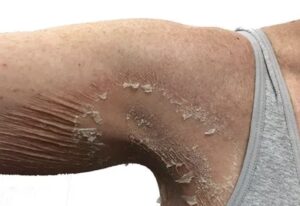
Granular Parakeratosis typically presents as red-to-brown patches. These lesions can appear as small bumps (papules) or larger, flat-topped areas (plaques). Their texture is often described as:
- Scaly: Covered with flakes of dead skin.
- Hyperkeratotic: A clinical term for skin that has become significantly thickened or “crusty” in appearance.
These lesions can develop quickly over a few days or emerge slowly over several months. While they are often asymptomatic, some patients report significant itching (pruritus).
Common Locations
This condition predominantly occurs in intertriginous areas—the medical term for places where skin folds touch. The primary locations include:
- Axillae (Armpits): The most common site for the condition.
- Submammary folds: The area directly under the breasts.
- Abdominal folds.
- Inguinal folds (The groin).
The “So What?”: Why do these specific areas matter? These locations are uniquely susceptible because they are prone to moisture and heat. When skin-on-skin contact occurs in these folds, it creates a micro-environment that disrupts the skin’s normal shedding process, leading to the characteristic thickening seen in Granular Parakeratosis.
3. Why Does This Happen? Understanding the Causes
In dermatology, it is just as important to debunk myths as it is to identify facts. Patients often worry that a lack of hygiene or a specific product is to blame, but the reality is more nuanced.
The Role of “Occlusion”
Granular Parakeratosis is considered idiopathic, meaning the exact underlying cause remains unknown. However, we have identified a primary contributor: occlusion. Occlusion occurs when moisture and heat are trapped against the skin. We know this is a factor because the condition thrives in skin folds and often clears up once the skin is allowed to stay dry.
Addressing Hygiene and Clinical Nuance
Historically, it was suspected that personal hygiene products, specifically deodorants or antiperspirants, caused this as a form of contact dermatitis. However, this theory has been largely discredited, as the condition frequently appears in patients who do not use these products. While a reaction to other “topical preparations” (creams or lotions) is still possible, it is rarely the sole cause.
Additionally, there is no sufficient evidence that the condition is caused by a bacterial or fungal infection. However, you should not be surprised if a physician suggests certain medications typically used for infections; clinical data shows that some cases have improved with oral antibiotics, likely due to their secondary effects rather than the presence of an actual infection.
4. Am I at Risk? Identifying Key Factors
Understanding risk factors helps place a diagnosis into context. While Granular Parakeratosis can affect anyone, certain demographic trends are evident in clinical data.
- Age and Gender: While reported in individuals of all ages, it is most frequently diagnosed in adults and shows a significantly higher prevalence in women.
- Geographical and Racial Factors: There is no known predilection for any specific race or geographic location.
- The Connection to Obesity: Clinical observations suggest a link between obesity and this condition.
The “So What?”: The association with obesity is not due to a metabolic issue, but rather a physical one. Increased body mass often results in more prominent or deeper skin folds (intertriginous areas). This increase in skin-on-skin contact creates more opportunities for heat and moisture to be trapped, providing the ideal environment for this reaction pattern to thrive.
5. How Can I Manage This? Self-Care and Professional Strategies
Because Granular Parakeratosis is often “self-limiting”—meaning it can resolve on its own—you have a high degree of agency in managing the condition through environmental changes.
Essential Self-Care Steps
- Remove Occlusion: The most critical step is to keep the affected skin folds cool and dry. Aim to minimize skin-on-skin friction and moisture buildup.
- Discontinue Potential Irritants: Stop using any topical preparations, creams, or hygiene products in the affected area that could be contributing to skin irritation.
- General Avoidance: Protect the skin from harsh chemicals or abrasive scrubbing, which can worsen the thickening.
Professional Management Options
Because treatment responses to medications (like topical steroids, retinoids, or oral isotretinoin) are often inconsistent and there is no known “cure,” environmental changes remain the foundation of care. However, if excessive sweating (axillary hyperhidrosis) is a factor in the armpits, your doctor may suggest Botox as a management option to help keep the area dry.
6. The Path to Recovery: What Is the Long-Term Outlook?
Patience is a vital component of dermatological healing. Because the skin needs time to reset its growth and shedding cycle, recovery does not happen overnight.
Prognosis and Timeline
- Resolution: Most cases resolve spontaneously within a timeframe of one month to one year.
- Chronic Persistence: While rare, you should be aware that some cases have been reported to persist or recur for as long as 20 years.
- Systemic Safety: It is vital to remember that Granular Parakeratosis is not associated with malignancy (cancer) or any body-wide systemic diseases. It is a localized skin issue.
7. When to See Your Doctor: Diagnosis and Professional Care
While the appearance of Granular Parakeratosis is distinct, a professional evaluation is necessary to rule out other conditions that require very different treatments.
The Diagnostic Process
To confirm the diagnosis, a dermatologist may perform a punch or shave biopsy. This involves taking a small sample of the skin for histopathologic evaluation. Under a microscope, we examine the specific layers of the skin—specifically the granular layer—to identify the characteristic retention of nuclei and the presence of keratohyalin granules that define this condition.
Why Professional Evaluation Matters
Several other skin conditions can mimic Granular Parakeratosis. A professional diagnosis helps rule out “look-alikes” such as:
- Seborrheic dermatitis: Common inflammatory patches with erythematous scale.
- Tinea corporis: A fungal infection (ringworm).
- Acanthosis nigricans: Velvet, hyperpigmented thickened plaques in flexural areas.
- Hailey-Hailey disease: Macerated plaques with a moist, weeping appearance.
- Darier’s disease: Crusted papules in skin folds, often linked to family history.
While there is no definitive “cure” for Granular Parakeratosis, it is a manageable and typically temporary condition. By focusing on keeping the skin cool, dry, and free of irritants, most patients see a full resolution of their symptoms.