
Quick Summary: A keloid is a firm, raised, and often uncomfortable scar growth that extends beyond the boundaries of the original skin injury. While they can be stubborn and resistant to standard care, successful management is achievable through early professional evaluation and a combination of specialized clinical therapies.
What Is Causing This Raised Growth?
Understanding how your skin repairs itself after trauma is a strategic first step in managing keloids. When your skin is injured, it produces a fibrous tissue called collagen to close and heal the wound. In individuals prone to keloid scar formation, this biological response gets stuck in an “overdrive” phase, leading to an excessive and continuous production of collagen, elastin, and scar tissue cells.
The development of a keloid can be thought of as a “hypersensitive healing” response. Unlike normal scars that stay flat and fade over time, keloids actively expand, pushing past the original site of inflammation or injury. Identifying this overgrowth pattern early is key to stopping the cycle before the scar tissue hardens and grows larger.

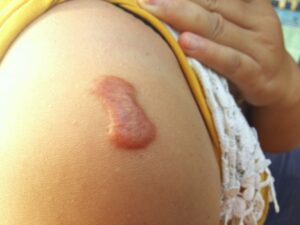
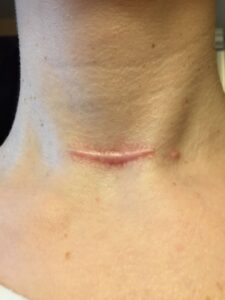
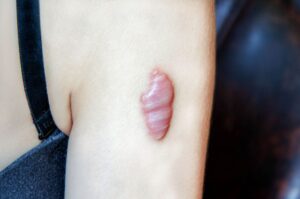
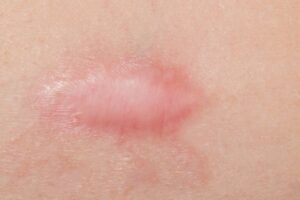
Understanding the Condition: Keloids vs. Hypertrophic Scars
It is clinically essential to distinguish a keloid from a standard hypertrophic scar, as their growth behaviors and treatment responses are completely different.
| Scar Feature | Key Differentiators |
|---|---|
| Hypertrophic Scar | Growth: Remains strictly confined within the boundaries of the original injury. Timeline: Appears within weeks of injury and often flattens or regresses spontaneously over time. |
| Keloid Scar | Growth: Invades adjacent healthy skin, expanding well beyond the original wound margins. Timeline: Can develop months or years after the initial trauma and tends to persist indefinitely without resolving on its own. |
Am I at risk for keloids?
Keloids are a structural, genetic skin tendency and are entirely unrelated to personal hygiene or skin cleanliness. Susceptibility relies heavily on your biological background and the location of a skin injury.
- Skin Phototype: Keloids are significantly more common in individuals with darker skin complexions (Fitzpatrick Skin Types III to VI), demonstrating a high prevalence in Black individuals and people of South Asian descent.
- Anatomic Hotspots: Certain areas of the body are under higher structural skin tension, making them exceptionally prone to keloids. These include the upper chest, shoulders, earlobes, and neck.
- Prior Injury Triggers: Any disruption to the skin barrier can spark keloid growth in susceptible individuals. Common triggers include surgical incisions, body piercings, minor cuts, burns, bug bites, cryotherapy, or inflammatory skin conditions like acne and shingles. In rare instances, they can even arise spontaneously without a known injury.
- Family History: A genetic predisposition is common, often showing a pattern among close relatives.
Where and How It Appears on My Body
Keloids display specific physical landmarks that distinguish them from other types of skin tumors or cysts.
- The Elevating Mass: They typically present as firm, thick, dome-shaped, or linear nodules that feel hard or rubbery to the touch.
- Surface Texture: The surface of a keloid is usually smooth, hairless, and can look shiny or glossy.
- Coloration Profile: They are frequently pink, bright red, or a purplish-red hue. In deeper skin tones, mature keloids often become significantly hyperpigmented (dark brown or black).
- Associated Symptoms: Unlike passive scars, active keloids are often physically uncomfortable, causing localized pain, tenderness, or intense, persistent itching.
Solutions I Can Try at Home
Because keloids are driven by an aggressive cellular process beneath the surface, home management is focused on protecting the scar from irritation and helping to soften the tissue barrier.
- Do Not Pick or Scratch: Scratching or picking at a keloid will aggravate the underlying fibroblasts, causing the scar to grow even larger and release more inflammatory signals.
- Silicone Gel Sheets: Applying specialized silicone gel sheets under occlusion daily for up to 6 months can help hydrate the scar tissue, compress the area gently, and slow down overactive collagen production.
- Friction Mitigation: Avoid tight clothing or rough fabrics that rub against the scar, especially around the chest line, shoulders, and neckline.
- Proactive Prevention: If you know you are prone to keloids, avoid elective cosmetic procedures, tattoos, or body piercings in high-risk areas. If you must undergo necessary surgery, inform your surgeon beforehand so preventative suturing techniques can be used.
When Should I See a Dermatology Provider?
Patience alone will not resolve a keloid. Seeking professional triage early is the most effective path, as smaller, newer keloids respond far better to medical therapies than old, heavily established masses.
Seek Professional Help if You Notice These “Red Flags”:
- Functional Limitation: The scar tissue is growing across a joint or muscle, restricting your range of motion or causing physical impairment.
- Intense Pain or Unmanageable Itch: The growth is persistently painful, tender to the touch, or itching so severely that it disrupts your daily activities or sleep.
- Rapid Expansion: The scar is quickly climbing outwards into adjacent healthy skin or changing its shape and color profile rapidly.
- Diagnostic Doubt: The growth bleeds spontaneously, develops an ulcerated surface, or lacks a history of skin trauma, meaning it must be evaluated to rule out rare aggressive skin tumors.
Frequently Asked Questions
- Q: How do clinical steroid injections help flatten a keloid?
A: Your provider can inject a targeted medication called Kenalog (triamcinolone) directly into the heart of the keloid. This works by slowing down the overactive fibroblasts and breaking up the dense bundles of thick collagen. Injections are typically performed in a series of monthly sessions until the scar softens and flattens. - Q: Can a keloid just be surgically cut off?
A: Simple surgical excision alone is generally discouraged because keloids carry an exceptionally high recurrence rate; cutting them out without a secondary therapy often causes them to grow back even larger. However, surgery can be highly successful if it is immediately combined with a post-surgical treatment plan, such as electron beam radiation therapy or serial monthly corticosteroid injections starting two weeks after the procedure. - Q: What other combinations of treatments are available?
A: Modern dermatology utilizes a multifaceted approach. To achieve the best results, your provider may combine liquid nitrogen cryotherapy immediately before a steroid injection to help the medication penetrate better, use a specialized mixture of Kenalog and 5-Fluorouracil (5-FU) to suppress cell division, or incorporate specialized pulsed dye laser (PDL) treatments to target the redness and blood supply feeding the scar.
The long-term outlook for keloids requires patience and clinical collaboration. While complete disappearance of the scar is uncommon, sticking closely to a personalized maintenance routine can successfully soften the tissue, eliminate pain and itching, and dramatically improve the scar’s visual appearance.