
Quick Summary: Sweet syndrome, also known as Acute Febrile Neutrophilic Dermatosis (AFND), is a rare inflammatory skin condition characterized by the abrupt onset of painful, red, or purplish skin lesions and fever [cite: 1755, 1761, 1836, 1842]. Although many cases are idiopathic, it can be associated with infections, inflammatory diseases, or underlying malignancies [cite: 1769, 1770, 1771, 1772]. Early clinical diagnosis supported by a professional skin biopsy is essential to guide swift systemic treatment and ensure long-term health monitoring [cite: 1782, 1783, 1837, 1839].
What Is Causing These Painful Red Skin Plaques?
Understanding how your body’s immune pathways and white blood cells interact is a strategic first step in managing Sweet syndrome. This condition is fundamentally an autoinflammatory disorder, meaning the body’s immune defenses mistakenly launch an intense inflammatory response without an active, live infection in the skin itself [cite: 1843, 1860]. Sweet syndrome does not arise from poor personal hygiene or a lack of personal cleanliness.
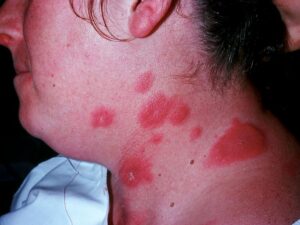
Instead, the underlying disease process identifies Sweet syndrome as one of the neutrophilic dermatoses [cite: 1801, 1860]. This means it is driven by an overactive, dense accumulation of specific immune cells called neutrophils directly within the deeper skin layer, known as the dermis [cite: 1784, 1847, 1859]. Scientific hypotheses suggest that an overproduction of pro-inflammatory signaling proteins (cytokines), such as interleukin-1 (IL-1) and tumor necrosis factor alpha (TNFα), acts as an internal accelerator, causing neutrophil activation and tissue swelling [cite: 1778, 1779, 1846, 1871].
You can think of an active Sweet syndrome flare-up as an internal “cellular defense alarm” gone haywire. Identifying this condition early through an expert clinical evaluation is the essential “So What?” factor in your recovery plan [cite: 1837]. Because it is driven by this deep, systemic neuro-immune signal rather than a surface allergen, standard over-the-counter antibiotic ointments are completely ineffective, making targeted, path-specific systemic anti-inflammatory therapies necessary to calm the hyperactive baseline [cite: 1796, 1823, 1838].
Understanding the Condition: Comparing Sweet Syndrome to Pyoderma Gangrenosum
Sweet syndrome belongs to the same broad family of neutrophilic dermatoses as another rare autoinflammatory skin condition called Pyoderma Gangrenosum (PG) [cite: 1674, 1737, 1801, 1860]. Recognizing the unique physical and structural variations between these conditions prevents clinical confusion and directs your provider toward the right therapeutic approach [cite: 1800, 1837].
| Neutrophilic Condition | Key Differentiators and Visual Configurations |
|---|---|
| Sweet Syndrome | Appearance: Characterized by the abrupt onset of solid, raised, red or purplish bumps, plaques, or nodules [cite: 1761, 1762, 1790]. These plaques feel swollen and thick but typically stay solid [cite: 1761, 1762]. They are highly unique because they lack surface scaling and rarely progress into deep, hollowed-out tissue ulcerations [cite: 1762, 1802]. |
| Pyoderma Gangrenosum (PG) | Appearance: Characterized by rapidly expanding, deep, and destructive skin ulcers [cite: 1664, 1802]. Lesions quickly break open from small bumps or pustules into deep sores featuring an overhanging, distinct blue or purple “undermined” edge and a necrotic base [cite: 1665, 1666]. |
Am I at risk for Sweet syndrome or severe internal complications?
Developing Sweet syndrome is an acute autoinflammatory event [cite: 1761, 1843]. It has absolutely zero connection to personal lifestyle errors, hygiene flaws, or contagious environmental exposures [cite: 1860].
- The Gender and Age Demographics: Anyone can technically develop Sweet syndrome [cite: 1781]. However, it demonstrates a clear statistical preference for women, predominantly targeting females between the ages of 30 and 50 [cite: 1781].
- The Malignancy Link: A primary reason for comprehensive screening is that Sweet syndrome can be associated with internal malignancies [cite: 1772, 1781, 1839]. It can arise as a secondary reactive phenomenon triggered by underlying blood disorders (such as acute leukemia or myelodysplasia) or internal solid tumors of the bowel, breast, or genitourinary tract [cite: 1772, 1833, 1858].
- The Pathergy Trigger: Your skin cells can exhibit a specialized, hyper-reactive trait known as **pathergy** [cite: 1775, 1864]. This means minor skin trauma, superficial scratches, or even the small needle prick from an intravenous (IV) site can act as a direct physical trigger to initiate a new, painful Sweet syndrome plaque right at the injury location [cite: 1775, 1864].
- The VEXAS Syndrome Risk Matrix: In marked contrast to the typical female demographic, when Sweet-like skin symptoms—such as urticarial nodules or sudden swelling around the eyes (periorbital angioedema)—surface in **males over the age of 50**, it can indicate a severe autoinflammatory disorder called **VEXAS syndrome** [cite: 1817, 1818]. Key indicators include persistent fevers, cytopenias (low blood cell counts), and characteristic vacuolation inside bone marrow cells [cite: 1819].
Where and How It Appears on My Body
Sweet syndrome lesions leave a distinct physical map across your skin, displaying characteristic visual landmarks that help your dermatology provider distinguish it from simple allergies or infections [cite: 1800, 1837].
- The Asymmetric Distribution: The painful, raised plaques predominantly populate the upper parts of the body—frequently grouping asymmetrically across the limbs, the neck, and the face [cite: 1761, 1765].
- Neutrophilic Dermatosis of the Hands (NDDH): A highly distinct, localized variant can map its visual profile explicitly onto the hands [cite: 1766, 1861]. This form creates dense, dense clusters of painful nodules restricted to the backs of the fingers, hands, and wrists [cite: 1766, 1861]. Unlike simple local hand vasculitis, NDDH is characteristically accompanied by systemic fever and malaise [cite: 1803].
- The Photodistributed Template: Lesions frequently demonstrate a powerful biological preference for sun-exposed landscapes, aligning along the contours of the neck and arms following direct ultraviolet light exposure [cite: 1777, 1875].
- Muted Complexion Clues: On deeper skin complexions, the bright crimson redness of the active plaques can look muted, dusky purple, or hyperpigmented dark brown [cite: 1761, 1790]. On skin of color, tracing the raised, thickened borders and evaluating local skin temperature (feeling if the bumps are noticeably warm or hot to the touch) are vital anchors used to identify active changes [cite: 1761].
Solutions I Can Try at Home
Because Sweet syndrome is a deep-seated, systemic inflammatory condition driven by internal cytokine networks, standard topical anti-itch lotions provide zero benefit [cite: 1761, 1823]. At-home support focuses heavily on protecting your skin barrier and avoiding mechanical irritation [cite: 1763, 1820].
- Meticulously Protect Skin from Injury: Avoid all accidental scratches, cuts, or skin friction, and exercise extreme caution near medical needles or IV sites [cite: 1775]. Because of the pathergy effect, minor skin trauma can prompt a new, painful plaque to erupt directly at the site of injury [cite: 1775, 1864].
- Gently Log Systemic and Skin Changes: Maintain a clear, written timeline of your flare-up [cite: 1837]. Keep a precise log tracking your daily body temperature and noting whether any new spots are preceded by upper respiratory or gastrointestinal issues, which provides your clinical team with essential minor diagnostic criteria [cite: 1770, 1793, 1794].
- Avoid Aggressive Surface Scrubbing: Never try to physically rub active plaques or exfoliate the skin bumps [cite: 1761, 1763]. Because the neutrophil clustering occurs deep within the dermis rather than on the surface layer, aggressive scrubbing breaks your skin barrier lines and intensifies local pain without flattening the spots [cite: 1763, 1784, 1847].
When Should I See a Dermatology Provider?
Sweet syndrome is a progressive condition that will not clear with over-the-counter hydrocortisone creams [cite: 1796, 1823]. Seeking professional clinical triage early is important to confirm your diagnosis through a precise **4mm punch skin biopsy** that specifically extends into the deep dermis and subcutaneous tissue to evaluate the core cellular architecture and rule out deep fungal or bacterial mimics [cite: 1782, 1783, 1816].
Seek Professional Help immediately if You Notice These Warning Signs:
- Abrupt Onset of Painful Plaques and Fever: You experience a sudden explosion of tender, red-to-purplish skin bumps accompanied by an unprompted high fever, requiring urgent clinical evaluation [cite: 1761, 1788, 1790, 1793, 1794].
- Diagnostic Uncertainty: Your skin changes mimic common cellulitis or a drug allergy, but completely fail to improve after starting standard antibiotic regimens, indicating the need for a diagnostic skin biopsy and tissue cultures [cite: 1796, 1800, 1816].
- The Appearance of Localized Hand Bumps: Painful, swollen nodules begin developing across the backs of your fingers or wrists (NDDH), accompanied by significant malaise and joint pain [cite: 1766, 1794, 1857, 1861].
- Signs of Systemic Bone Marrow Shifts: Active skin eruptions in older adults are accompanied by profound fatigue, rapid unexplained bruising, or severe cytopenias, suggesting a underlying hematological complication that requires immediate bone marrow staging [cite: 1772, 1787, 1819, 1858].
Frequently Asked Questions
- Q: What exhaustive laboratory blood panel is mandatory to safely diagnose and evaluate Sweet syndrome?
A: Because Sweet syndrome can be triggered by internal malignancies or inflammatory conditions, a positive clinical suspicion requires an extensive testing panel [cite: 1769, 1782, 1839]. Your provider will order a **Complete Blood Count (CBC) with differential** to evaluate for elevated white blood cell counts or hematological anomalies, alongside a **Comprehensive Metabolic Panel (CMP-14)** to monitor systemic organ and GI function [cite: 1785, 1786, 1787, 1795]. This is paired with an Antinuclear Antibody (ANA) screening, Erythrocyte Sedimentation Rate (ESR), C-Reactive Protein (CRP) to track the systemic inflammatory baseline, and a **p-ANCA autoantibody test**, which can be characteristically positive in select cases [cite: 1785, 1797, 1798, 1848, 1866]. Complete cancer and malignancy screenings are also initiated [cite: 1839]. - Q: What is the gold-standard oral prescription corticosteroid protocol and taper schedule?
A: Systemic corticosteroids are the first-line treatment for Sweet syndrome, characteristically producing a dramatic clinical response and clearing fevers within 24 to 48 hours [cite: 1823, 1824, 1838, 1845]. Your provider will initiate **oral Prednisone dosed precisely at 0.75 mg/kg to 1 mg/kg daily** [cite: 1824]. Once your clinical response is successfully stabilized, your dermatologist will execute a highly structured, slow weaning protocol: **reducing the prednisone by 10 mg increments each week over the next 4 to 6 weeks** [cite: 1825]. This ensures most patients are completely weaned from steroids within a 6 to 8 week total treatment window [cite: 1826]. - Q: What advanced steroid-sparing medication options exist for chronic or recurrent disease?
A: While Sweet syndrome generally resolves smoothly without leaving permanent scars, approximately one-third to one-half of all patients may experience recurrent episodes, particularly those with persistent underlying inflammatory states or bone marrow disorders [cite: 1832, 1833]. For chronic, severe, or frequently relapsing cases where long-term steroids pose physical safety risks, your provider will introduce powerful steroid-sparing agents [cite: 1827]. First-line alternative choices include oral **Dapsone at 100–200 mg/day**, valued for its unique ability to safely inhibit hyperactive neutrophils [cite: 1828, 1859]. Alternatively, your team can incorporate oral cyclosporine, mycophenolate mofetil, or advanced biological agents to safely maintain long-term remission [cite: 1829, 1830].
The long-term outlook for the majority of Sweet syndrome patients is highly favorable when treated promptly, with skin plaques clearing beautifully without leaving permanent scars [cite: 1832]. Success relies on early clinicopathological verification via an office biopsy, strict adherence to your weekly medication taper, completing your comprehensive malignancy screening panel, and maintaining close follow-ups with your interprofessional dermatology team to keep your body safe and healthy [cite: 1782, 1825, 1837, 1839, 1840].