
Hidradenitis Suppurativa (HS) is a painful, chronic inflammatory skin condition characterized by recurrent tender lumps under the skin, deep fluid-filled collections (abscesses), and long-term scarring [cite: 3592, 3598, 3599]. HS is a complex disease spectrum that can range from isolated, painful bumps to deep tunnels connecting under the skin [cite: 3592, 3598, 3599, 3637]. While navigating this condition requires continuous patience, obtaining an accurate diagnosis, actively managing underlying metabolic links, and implementing a targeted medical or surgical care plan can break the loop of active flares, reduce pain, and drastically restore your quality of life [cite: 3620, 3637, 3642, 3695].
What Is Causing These Painful Under-Skin Lumps?
Understanding the internal structural behavior of your hair follicles and apocrine glands is a strategic first step in managing HS. This condition does not arise from a lack of cleanliness or poor personal hygiene. Instead, the biological process begins with an accumulation of cellular debris that causes follicular plugging of the apocrine glands [cite: 3606]. As a blocked follicle swells, it ruptures beneath the surface, spilling inflammatory contents into the surrounding skin layers [cite: 3606]. This rupture triggers an aggressive, overactive localized immune defense response [cite: 3607]. Your body overproduces key proinflammatory cytokines—specifically IL-1β, IL-17, and TNF-α—sending the area into a state of intense, painful deep-tissue inflammation [cite: 3598, 3607].
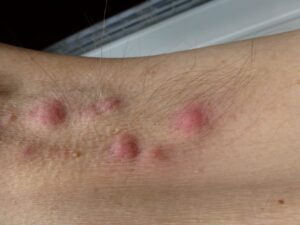
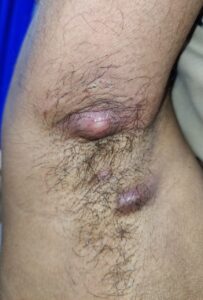

You can think of an active HS flare-up as an internal “cellular pressure cook” event [cite: 3606]. Over time, these recurrent deep-tissue breakdowns force the skin to form complex interconnected channels known as draining sinuses or tracts [cite: 3598, 3717]. Identifying this condition early through an expert clinical physical exam is the essential “So What?” factor in your recovery plan [cite: 3620]. Because HS is driven by this deep, systemic immunopathology, surface-level solutions alone cannot stop the cycle, making pathway-specific systemic therapies, structural treatments, and metabolic adjustments mandatory to protect your tissue lines [cite: 3607, 3637, 3642].
Understanding Your Disease Severity: The Three Stages of HS
HS presents along a predictable clinical continuum, moving from solitary inflammatory nodes to extensive scarring networks. Recognizing your specific stage helps guide your medical and surgical treatment algorithm [cite: 3637, 3650, 3662, 3674].
| Disease Stage | Key Characteristics and Structural Formations |
|---|---|
| Stage 1 (Mild) | Characterized by solitary or multiple isolated, tender subcutaneous inflammatory nodules and abscesses [cite: 3598, 3650]. At this early baseline stage, there is completely no evidence of sinus tracts, tunneling, or cicatricial scarring [cite: 3599]. |
| Stage 2 (Inflamed) | Recurrent abscesses expand and begin to coalesce, forming early draining sinus tracts beneath the surface skin [cite: 3598, 3717]. Localized, distinct hypertrophic scarring tracks begin to link separate nodules in a single region [cite: 3599]. |
| Stage 3 (Severe / Tunneling) | An advanced, aggressive manifestation where diffuse, interconnected columns of draining sinus tracts, tunnels, and deep dermal abscesses envelop an entire anatomical region [cite: 3598, 3674, 3717]. Widespread scarring and hard fibrous plaques replace normal skin architecture [cite: 3599, 3715]. |
Am I at risk for hidradenitis suppurativa complications?
Developing HS is an autoinflammatory event driven heavily by genetic predispositions and distinct hormonal and metabolic baseline pathways [cite: 3605].
- The Gender Axis: HS exhibits a profound demographic preference for women, affecting females three times more frequently than men (a 3:1 ratio) [cite: 3610]. Symptoms typically surface and peak between the second and third decades of life (ages 10 to 30) [cite: 3610].
- The Tobacco Trigger: Smoking acts as a massive primary biological engine for this disease, strongly altering follicular dynamics and serving as a major trigger for recurrent, severe flares [cite: 3608, 3699].
- The Metabolic Syndrome Intersection: HS is deeply intertwined with metabolic syndrome, truncal obesity, insulin resistance, and conditions of androgen excess like Polycystic Ovary Syndrome (PCOS) [cite: 3611, 3612, 3613, 3616]. High fasting insulin levels and insulin resistance directly aggravate the follicular plugging cycle [cite: 3606, 3645].
- Oncological & Obstetric Risks: Individuals with long-standing, chronic HS have a statistically documented increased lifetime risk of developing skin malignancies [cite: 3617, 3704]. Furthermore, pregnant individuals with active HS are classified clinically as high-risk pregnancies due to an elevated risk of premature labor and congenital anomalies [cite: 3618, 3704].
Where and How It Appears on My Body
HS leaves unmistakable physical landmarks and architectural clues across the high-moisture, friction-heavy skin creases of your body [cite: 3603].
- The Intertriginous Map: Lesions pop up symmetrically within major body folds—predominantly grouping inside the axillae (armpits), the inguinal creases of the groin, the anogenital region, and the folds beneath the breasts [cite: 3603].
- The Double Comedone Landmark: A highly unique clinical sign is the formation of the **double comedone**—a specialized blackhead structure featuring two or more separate surface openings that connect smoothly into a single tunnel beneath the skin’s surface [cite: 3600, 3720].
- The Chronic Sinus Discharge: Tunnels chronically exude a foul-smelling, purulent or blood-tinged drainage due to localized, secondary bacterial colonization trapped inside the dead space [cite: 3606, 3717].
- Muted Complexions: On deeper skin complexions, the background redness (erythema) surrounding an active nodule may appear muted, dusky, deep purple, or dark brown, resembling a bruise or deep hyperpigmentation rather than true redness [cite: 3598, 3752].
Solutions I Can Try at Home
Because moderate-to-severe HS is a deep-seated, systemic inflammatory condition, home care focuses on lifestyle trigger elimination and reducing physical stress on active skin folds [cite: 3637, 3638].
- Commit to Smoking Cessation: This is the single most critical behavioral tool you can implement [cite: 3638, 3703]. Eliminating tobacco directly removes a primary biochemical fuel source driving the follicular occlusion cycle [cite: 3606, 3608].
- Minimize Mechanical Friction: Switch to loose-fitting, soft clothing made of moisture-wicking fabrics, and rotate undergarment styles frequently to avoid continuous pressure on a single skin crease [cite: 3638]. If your job involves prolonged sitting, consider a sit-stand desk modification or use a specialized doughnut pillow to avoid compressing active groin lines [cite: 3638].
- Incorporate Early Laser Hair Removal: Explore long-pulse laser hair removal early in your disease timeline [cite: 3638]. Safely destroying the hair root matrix reduces the total volume of structures susceptible to follicular plugging [cite: 3606, 3638].
- Do Not Squeeze or Manually Pop: Squeezing an active subcutaneous nodule or trying to pop a deep dermal abscess at home is dangerous; it pushes the inflammatory tracking deeper into your tissue, worsens internal scarring, and increases severe local pain [cite: 3598, 3599].
When Should I See a Dermatology Provider?
HS is a progressive disease that will not resolve with over-the-counter acne washes [cite: 3637, 3694]. Seeking professional clinical triage early is essential to get an accurate diagnosis, undergo formal metabolic staging, and implement prescription interventions before permanent structural tunneling deforms the tissue lines [cite: 3598, 3599, 3620].
Seek Professional Help immediately if You Notice These Warning Signs:
- Exquisitely Painful Abscesses: Large, tense subcutaneous nodules become intensely painful, hot, or fluctuant, requiring an in-office **sterile incision and drainage (I&D)** or a precise **intralesional corticosteroid injection** to immediately provide relief and clear localized fluid [cite: 3639, 3640, 3737, 3738].
- Signs of Insulin Resistance: You notice multiple skin tags, central obesity, or velvety darkening of your neck folds (**acanthosis nigricans**), requiring immediate screening with a fasting glucose, hemoglobin A1c (HbA1c), and fasting insulin to initiate protective insulin-sensitizing therapies [cite: 3643, 3644, 3645, 3646].
- Persistent, Non-Healing Tunnels: Deep tracks under your armpits or groin continuously drain fluid or fail to heal, requiring surgical evaluation for advanced procedures like **surgical deroofing** or tissue-sparing laser surgery [cite: 3641, 3674, 3685, 3686, 3739].
Frequently Asked Questions
- Q: How do providers manage the metabolic and insulin pathways driving HS?
A: Because HS is heavily linked to insulin resistance, your provider will evaluate your metabolic health [cite: 3643, 3700]. If your panel reveals a dysregulated fasting insulin marker (with results climbing to 8, 9, 10 or higher), your dermatologist will prescribe **Metformin Extended Release (ER)** [cite: 3645, 3647]. You will start safely at Metformin ER 500 mg taken strictly with your morning meal (AM) to minimize gastrointestinal side effects [cite: 3647, 3648, 3682]. Your provider will escalate the dose by 500 mg every two weeks up to a target of 1500–2000 mg daily [cite: 3647]. Metformin is safe to use during pregnancy, but must never be prescribed if you have end-stage renal disease [cite: 3683, 3684]. Advanced GLP-1 inhibitors may also be added to optimize weight and calm inflammation [cite: 3649]. - Q: What specific prescription antibiotic algorithms are used for inflamed stages?
A: For Stage 2 inflamed disease, oral antibiotics serve as a primary clinical mainstay [cite: 3662, 3666]. First-line choices include Doxycycline 100mg twice daily or Minocycline 100mg twice daily [cite: 3667, 3668]. For resistant or deep tissue infections, your provider will transition you to a powerful 10-week combination course of **Clindamycin 300mg twice daily paired with Rifampicin 300mg twice daily** [cite: 3670]. To minimize stomach upset, you will start the Rifampin alone for the first 7 days before adding the Clindamycin into your routine [cite: 3671]. For aggressive rescue scenarios, a short 4-week course of Linezolid 600mg twice daily can be utilized [cite: 3673]. Your clinic team will routinely perform a swab culture on actively draining fluid to tailor these selections precisely based on bacterial sensitivity results [cite: 3640]. - Q: What options are available to manage sudden, intense disease flares?
A: At the very first sign of an explosive, painful flare, your provider will initiate a high-dose **steroid rescue** protocol [cite: 3675, 3691]. This involves taking 20–40 mg of prednisone daily for 3 days to rapidly cool the immune system [cite: 3691]. For severe tunneling blockages, you will undergo an intense systemic taper starting at 80 mg of prednisone for 3 days, followed by a reduction of 10 mg every 3 days until complete [cite: 3676]. If a patient requires long-term maintenance low-dose steroids (5–10 mg daily), your provider will strictly monitor your calcium levels, Vitamin D markers, blood glucose, and order regular DEXA bone density scans to ensure complete physical safety [cite: 3687, 3689, 3690, 3750]. Advanced long-term control is achieved by moving to biological anti-TNF therapies [cite: 3607, 3677, 3747].
The long-term outlook for hidradenitis suppurativa involves focusing on early, continuous management to control cellular pathways, minimize permanent tissue changes, and protect your mobility [cite: 3693, 3695]. Success relies on immediate smoking cessation, strict adherence to your morning metabolic or rotating medication routine, and establishing a regular relationship with your interprofessional dermatology team to keep your body vibrant and fully supported [cite: 3638, 3647, 3702, 3703].