
Quick Summary: Erythema Nodosum (EN) is a common inflammatory skin condition characterized by the sudden appearance of painful, tender bumps beneath the skin, most typically located on the shins [cite: 2015, 2021, 2026, 2061]. Although it is a self-limiting reaction pattern that usually resolves completely on its own, it functions as an important immune warning flag that can indicate an underlying systemic trigger [cite: 2028, 2029, 2050]. Clinical management focuses on confirming the diagnosis, pinpointing and treating any underlying root cause, and soothing localized discomfort [cite: 2062, 2063].
What Is Causing These Painful Bumps on My Shins?
Understanding how your body’s immune pathways respond to external and internal triggers is a strategic first step in managing Erythema Nodosum. EN is fundamentally an inflammatory condition affecting the subcutaneous fat layer beneath your skin, operating as a delayed-type hypersensitivity reaction (Type IV immune response) [cite: 2028, 2066]. It has absolutely zero connection to poor personal hygiene or a lack of personal cleanliness.

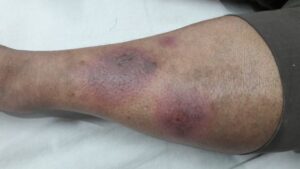
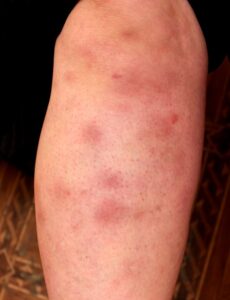
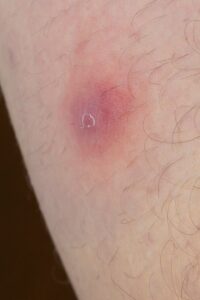
Instead, your white blood cells launch an exaggerated immune defense response to an internal antigen exposure [cite: 2028]. This prompts a dense influx of lymphocytes and neutrophils to pack into the septa between your fat lobules—a localized tissue reaction known to pathologists as septal panniculitis [cite: 2043, 2068]. You can think of an EN flare-up as an internal “immune alarm response” activated in your deep tissue [cite: 2028].
The triggers that can set off this hypersensitivity alarm highway are highly diverse and include [cite: 2030]:
- Infectious Triggers: Streptococcal infections (the most common cause in pediatric populations), tuberculosis, *Yersinia*, *Chlamydia*, *Campylobacter*, *Salmonella*, viral hepatitis, HIV, or deep fungal and parasitic microbes [cite: 2031, 2032].
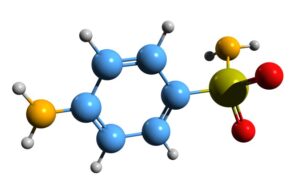
- Medication Exposures: Common everyday drugs, including oral contraceptive pills containing estrogens, sulfonamide antibiotics, amoxicillin, nonsteroidal anti-inflammatory drugs (NSAIDs), bromides, salicylates, and iodides [cite: 2033, 2039].
- Underlying Inflammatory Disorders: Systemic conditions such as Sarcoidosis, Inflammatory Bowel Disease (Crohn’s disease or ulcerative colitis), and Behçet’s disease [cite: 2034].
- Other Physiological Shifts: Normal pregnancy or underlying internal malignancies (such as lymphoma and leukemia) [cite: 2035].
Identifying this condition early through an expert clinical evaluation is the essential “So What?” factor in your health routine [cite: 2041]. Because EN can be a surface presentation of a hidden, system-wide disorder, catching it early allows your healthcare team to find and treat the primary trigger before broader medical complications develop [cite: 2029, 2062].
Understanding the Condition: Comparing EN to Erythema Induratum
Because Erythema Nodosum creates tender nodules on the lower limbs, it must be carefully distinguished from other forms of deep fat inflammation (panniculitis) [cite: 2044, 2067]. Recognizing these core clinical differences prevents medical confusion and directs your provider toward the correct therapeutic algorithm [cite: 2041, 2044].
| Subcutaneous Condition | Key Differentiators, Pathology, and Behaviors |
|---|---|
| Erythema Nodosum (EN) | Anatomy & Features: Crops of tender, deep nodules populating the anterior shins [cite: 2021, 2026]. They appear bright-to-deep red and resolve cleanly like a bruise [cite: 2022]. Crucially, true EN nodules are strictly non-ulcerating and **completely preserve the outer skin layer without breaking open into sores** [cite: 2045, 2078]. Biopsy reveals a clean septal panniculitis [cite: 2043, 2068]. |
Erythema Induratum (Nodular Vasculitis) | Anatomy & Features: Deep nodules that characteristically favor the posterior calves rather than the shins [cite: 2045]. These lesions follow a chronic path and **frequently break open into raw, draining, and weeping ulcers** [cite: 2045, 2078]. This condition represents a lobular panniculitis associated with vasculitis, which historically carries a strong genetic tie to tuberculosis [cite: 2045, 2046, 2069, 2076]. |
Am I at risk for Erythema Nodosum or severe recurrences?
Developing Erythema Nodosum is an acute hypersensitivity and autoinflammatory response [cite: 2028, 2061]. It can affect individuals of any age, background, or ethnicity, but specific profiles alter your baseline risks [cite: 2037].
- The Female Predominance: EN exhibits a powerful demographic preference for young-to-middle-aged adult populations, demonstrating a peak clinical prevalence in women between the ages of 25 and 40 [cite: 2037]. Statistically, adult women are 3 to 6 times more likely to be affected than men [cite: 2038].
- Hormonal Co-Factors: Using estrogen-containing medications, specifically oral contraceptive pills, serves as a direct hormonal co-factor that can destabilize your vascular and immune reactivity lines [cite: 2039].
- The Relapse Trajectory: While the vast majority of cases resolve perfectly without issues, individuals with underlying chronic medical conditions—such as a persistent, active inflammatory bowel disease flare—face a statistically higher risk for experiencing chronic or recurrent relapses [cite: 2034, 2059].
- Systemic Flu-Like Signs: The arrival of the skin bumps is frequently accompanied by prominent, systemic flu-like symptoms [cite: 2024]. It is entirely normal to experience severe generalized fatigue, a high fever, and significant joint pain (arthralgia) or joint swelling right as the crop erupts on your legs [cite: 2024, 2075].
Where and How It Appears on My Body
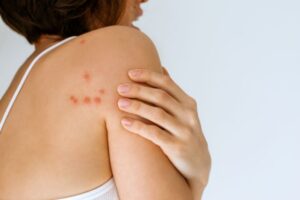
EN nodules follow a highly targeted anatomical map across your skin, leaving distinct landmarks that help your dermatology provider instantly separate them from standard insect bites or skin surface infections [cite: 2026, 2048, 2061].
- The Anterior Shin Anchor: The painful, deep-seated nodules demonstrate a massive biological preference for the anterior shins (the front of the lower legs) [cite: 2026]. Secondary regions can include the front of the thighs and the extensor forearms [cite: 2026].
- The Bruise-Like Evolution: Nodules range from 3 to 20 cm in diameter [cite: 2023]. They begin as highly visible, tense, bright-to-deep red bumps [cite: 2021, 2022]. Over a 2-to-3 week lifecycle, they naturally flatten out and transition through a spectrum of colors—turning purplish, yellowish, or green—resolving completely with a distinct, temporary **bruise-like appearance** [cite: 2022, 2058].
- Muted Complexion Clues: On deeper skin tones, the initial bright red flush can appear muted, dusky purple, or deeply hyperpigmented dark brown [cite: 2022]. On skin of color, evaluating localized skin tenderness (noting if the bumps feel exquisitely painful upon light pressure) and tracing the deep-seated swelling are vital anchors used to identify active changes [cite: 2021, 2022].
Solutions I Can Try at Home
Because Erythema Nodosum is an internally driven hypersensitivity tissue reaction located deep within your subcutaneous fat, surface lotions provide very limited relief [cite: 2028, 2067]. At-home support focuses entirely on mechanical rest and reducing fluid pressure on your lower limbs [cite: 2052].
- Enforce Strict Bed Rest and Leg Elevation: This is your single most effective at-home healing tool [cite: 2052]. Elevate your legs above the level of your heart as frequently as possible during an active flare [cite: 2052]. Reducing the mechanical pressure of gravity decreases localized tissue fluid retention (edema) and immediately eases severe, throbbing leg pain [cite: 2052, 2075].
- Utilize Gentle Support Compression: When you must stand or walk, utilize support compression bandages or stockings on your lower limbs [cite: 2052]. Compression helps stabilize the deep tissue layers and limits painful vascular engorgement [cite: 2052].
- Gently Log Systemic Changes: Maintain a clear photographic and written diary of your nodules [cite: 2041]. Document your highest daily body temperature and note if you experienced a sore throat or diarrhea in the weeks before the rash, which provides your clinical team with essential clues to uncover the infectious trigger [cite: 2031, 2032, 2062].
- Never Attempt to Manually Pop: Do not squeeze, press hard, or try to pick at the discolored skin patches [cite: 2021]. True EN nodules contain solid, deep inflammatory fat layers rather than liquid surface pus; manually squeezing them will only intensify your localized pain and worsen underlying tissue stress [cite: 2021, 2067].
When Should I See a Dermatology Provider?
Erythema Nodosum can easily hide or mimic other conditions like cutaneous polyarteritis nodosa or deep skin infections [cite: 2047, 2048]. Seeking professional clinical triage early is important to confirm your diagnosis and ensure a thorough investigation is initiated [cite: 2029, 2041].
Seek Professional Help if You Notice These Warning Signs:
- Unmanageable or Disabling Leg Pain: The intense tenderness and joint swelling prevent you from walking comfortably, sleeping through the night, or performing daily activities [cite: 2024, 2050].
- Diagnostic Uncertainty or Atypical Progressions: Your nodules are accompanied by a mottled, net-like vascular pattern on your skin (livedo) or begin breaking open into open sores (ulcerations), requiring a diagnostic **deep 4mm punch skin biopsy** [cite: 2041, 2047, 2077, 2078]. To confirm panniculitis, your provider must perform a biopsy that explicitly extends deep enough to include the subcutaneous fat layer so the pathologist can visualize the septal architecture [cite: 2042, 2043, 2070].
- Signs of a Chronic or Long-Standing Course: Active nodules persist completely unchanged past 4 to 6 weeks, fail to show bruise-like resolution, or continuously return, requiring advanced medical intervention [cite: 2022, 2050, 2056].
Frequently Asked Questions
- Q: What extensive multi-system laboratory screening is mandatory to evaluate the underlying EN trigger?
A: Because Erythema Nodosum is frequently an external warning flag for an internal systemic disorder, a positive diagnosis triggers a thorough medical workup [cite: 2028, 2029]. Your provider will order a comprehensive baseline testing panel [cite: 2041]. This includes a Complete Blood Count (CBC) with differential, a Comprehensive Metabolic Panel (CMP-14) to screen for liver or bowel issues, an Antinuclear Antibody (ANA) test, and inflammatory markers (ESR and CRP) [cite: 2034, 2041]. To isolate infectious or inflammatory root causes, your team will order a **tuberculin skin test or IGRA to screen for hidden tuberculosis, a posteroanterior chest radiograph (CXR) to check for the bilateral hilar lymphadenopathy seen in Sarcoidosis**, and targeted screens for streptococcal or gastrointestinal pathogens [cite: 2031, 2034, 2041]. A formal pregnancy test is also mandatory for females of childbearing age [cite: 2035, 2041]. - Q: What primary oral prescription medications are available to manage severe pain and inflammation?
A: For typical, uncomplicated cases, the condition is self-limiting and your care will focus on comfort [cite: 2050]. To aggressively control active tissue pain and joint distress, your provider will prescribe targeted first-line anti-inflammatory medications [cite: 2053]. This includes prescription-strength **NSAIDs such as ibuprofen or naproxen** [cite: 2053]. Alternatively, your dermatologist can implement highly effective alternative first-line therapies, including oral **Indomethacin** or a structured course of **oral potassium iodide (SSKI) liquid drops** to rapidly encourage the clearing of deep fat nodules [cite: 2054, 2067]. - Q: What advanced treatment steps exist for severe, chronic, or frequently relapsing disease?
A: If your condition is exceptionally severe, fails first-line NSAIDs, or takes on a chronic, relapsing course, your provider will step up care to advanced interventions [cite: 2050, 2055, 2056]. Your dermatologist can perform **intralesional triamcinolone acetonide steroid injections** directly into the core of stubborn nodules to rapidly melt local inflammation [cite: 2055]. For severe, non-infectious cases, short courses of systemic oral corticosteroids can be utilized [cite: 2055]. Crucially, if you suffer from long-standing chronic or recurrent EN associated with persistent underlying conditions like inflammatory bowel disease, your provider will prescribe targeted long-term maintenance medications, specifically oral **Hydroxychloroquine or Dapsone**, to safely stabilize your deep tissue baseline [cite: 2056].
The long-term outlook for the vast majority of individuals with Erythema Nodosum is excellent, with most healthy patients experiencing a complete, natural resolution of all symptoms and full skin clearing within 2 to 3 weeks [cite: 2058]. Success relies on identifying and correcting your primary environmental or internal trigger, maintaining strict leg rest and elevation during active attacks, and a close, collaborative partnership with your interprofessional dermatology team to keep your body healthy and fully protected [cite: 2052, 2062, 2064].