
Quick Summary: Seborrheic keratoses are common, completely benign skin growths that typically have a distinct "stuck-on" appearance. They pose absolutely zero threat to your physical health, requiring no medical treatment unless they become irritated, catch on clothing, or cause cosmetic concern.
What Is Causing These Waxy Growths?
Understanding the natural aging and degenerative shifts of your skin layers is a strategic first step in managing seborrheic keratoses. These growths, medically known as SKs, occur when the cells in the outer layer of your skin (keratinocytes) multiply in a localized cluster, often resulting in follicular plugging that creates visible “horn cysts” on the surface. You can think of a seborrheic keratosis as a safe, surface-level “waxy landmark” rather than an aggressive or dangerous cellular mutation.
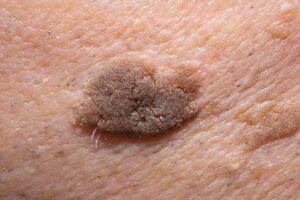
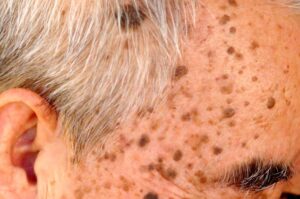
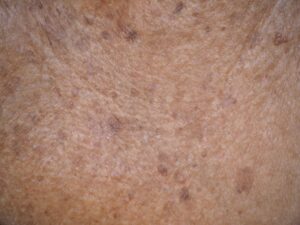
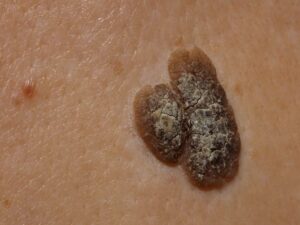
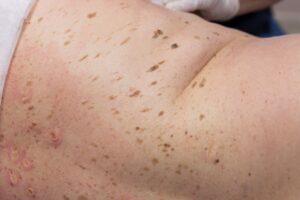
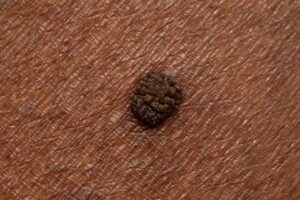
The root cause of these stable plaques is primarily related to genetic factors and the natural maturation of the skin, with certain genetic variations (like FGFR3 or PIK3CA) playing a role. Identifying these benign landmarks early is the “So What?” factor in your skincare routine, giving you complete peace of mind that they are entirely non-contagious and non-precancerous.
Understanding the Progression: From Flat Macules to Stuck-on Plaches
Seborrheic keratoses undergo structural transformations over time. Recognizing their evolution prevents unnecessary anxiety during your self-skin checks.
| Growth Stage | Key Characteristics and Visual Profiles |
|---|---|
| Early (Flat) | Presents as flat, well-demarcated tan, yellow, or light brown spots (macules) that blend smoothly into the surrounding skin, often mimicking simple sun spots. |
| Mature (Raised) | Transforms into raised papules or thick plaques with a distinct “stuck-on” look. The surface becomes waxy, velvety, or rough and cracked, with colors deepening to dark brown or solid black. Sizes range from 0.5cm to greater than 5cm. |
Am I at risk for seborrheic keratosis?
Developing seborrheic keratoses is an incredibly widespread aspect of adult skin development. They are entirely independent of personal hygiene or dietary toxins.
- The Age Threshold: Susceptibility expands significantly with time. They are most common in individuals aged 50 or older, and the total number and size of the lesions naturally expand as we grow older.
- Hormonal Milestones: It is common for SKs to surface or expand in number during pregnancy or during systemic estrogen-progesterone hormone therapies.
- Genetic Factors: Having a clear family history of seborrheic keratoses strongly predisposes you to a higher volume of these stable lesions over your lifetime.
Where and How It Appears on My Body
Seborrheic keratoses follow a broad distribution pattern across your hair-bearing skin, leaving helpful diagnostic clues for your provider.
- Anatomic Hotspots: They are most frequently observed on the face, neck, extremities, and the trunk—especially clustering across the upper back and chest.
- Anatomic Sparing: Because they require hair-bearing skin structures, seborrheic keratoses **never** develop on your mucous membranes, palms, or the soles of your feet.
- The “Stuck-On” Look: They look as if they have been pressed onto the skin surface like a piece of warm candle wax or a small button, with sharply defined borders.
Solutions I Can Try at Home
Because seborrheic keratoses are surface-level, stable structures, home management is focused entirely on skin comfort and preventing unnecessary irritation.
- Do Not Scratch or Pick: Attempting to scratch, pick, or peel away a raised plaque will only injure the underlying dermis, causing painful local inflammation, bleeding, and increasing the risk of a secondary infection.
- Meticulous Shaving Habits: If you have raised warty SK plaques on your face, neck, or limbs, execute extra care with your razor. Shaving nicks on an SK can cause sharp, persistent bleeding and a crusty texture.
- Moisturize and Monitor: Keep the skin well-hydrated to soothe any surface itchiness or clothing friction against the raised plaques.
When Should I See a Dermatology Provider?
While treatment is completely optional, a professional clinical evaluation provides certainty and ensures the lowest risk of altering your skin’s natural appearance.
Seek Professional Help if You Notice These “Red Flags”:
- Diagnostic Uncertainty with Dark Lesions: An SK grows very dark brown or solid black, lacks a clear warty texture, or shows irregular shifting borders. A dermatologist must perform an in-office shave removal to rule out a melanoma.
- The Sudden Eruption (Leser-Trélat Sign): The sudden, rapid explosion of dozens of new seborrheic keratoses across your body. While the growths themselves remain benign, this specific explosive sign can occasionally act as a paraneoplastic warning indicating an underlying internal malignancy.
- Friction, Bleeding, or Pruritus: A plaque becomes constantly irritated by your bra line or waistband, scratches open easily, or triggers severe, persistent itching.
- Choosing a Removal Method: You desire removal for cosmetic preference. Your provider can perform **cryotherapy** (freezing), which allows the lesion to detach cleanly within 3–4 weeks, or choose precise **electrosurgery and curettage** to dehydrate and scoop the lesion immediately, minimizing any risk of leaving a dark mark.
Frequently Asked Questions
- Q: What are these multiple tiny dark bumps on my cheeks that look like SKs?
A: If you have a deeper skin complexion (Fitzpatrick Phototypes IV-VI), you may develop **Dermatosis Papulosa Nigra (DPN)**. These are multiple small (1-3mm), smooth, dark brown or black papules clustering on the face and forehead. While structurally identical to tiny SKs, they must never be treated aggressively with liquid nitrogen or chemical peels, as freezing carries a high risk of leaving permanent white spots behind. Targeted in-office **electrodessication** is the safest approach for DPN. - Q: Will a seborrheic keratosis turn into skin cancer over time?
A: No. Seborrheic keratoses are entirely benign overgrowths of normal skin cells and possess zero potential to mutate into skin cancer. However, because skin cancers can occasionally hide adjacent to or mimic the appearance of an SK, any growth that behaves atypically should be formally evaluated. - Q: What can I expect after an in-office removal session?
A: If your provider uses cryotherapy, a thin blister may form, and the growth will crust over and flake off within a month. If curettage is used, the growth is gone instantly, leaving a shallow scrape. Any temporary pinkness, darkening, or minor color loss at the site typically fades and blends back in perfectly within 3 to 4 months.
The long-term outlook for seborrheic keratoses is outstanding, as they are completely safe, surface-level signs of mature skin. Success lies in annual professional validation, protecting the plaques from physical friction, and choosing precise, tissue-sparing clinical methods if you decide to clear the skin for cosmetic comfort.