
Quick Summary: Lichen striatus is a rare, benign skin condition that causes the sudden appearance of small, raised bumps arranged in a distinctive linear band. It is a completely harmless, self-limiting event that predominantly affects children and clears spontaneously over several months without requiring aggressive treatment.
What Is Causing This Linear Streak of Bumps?
Understanding how skin cells migrate during early structural development is a strategic first step in recognizing lichen striatus. The exact cause of this condition is unknown, but it is tied to genetic factors and environmental triggers. You can think of the linear path as an invisible embryonic map known as Blaschko’s lines—imaginary tracks that skin cells follow as they develop before birth. When a trigger activates these specific cells, they produce a localized inflammatory response that climbs along these exact paths.
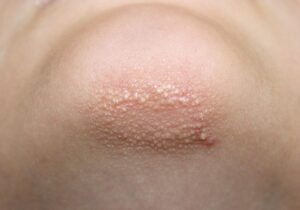
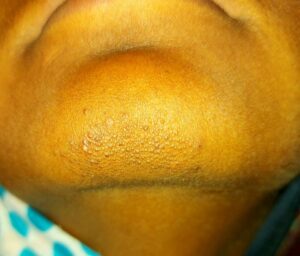
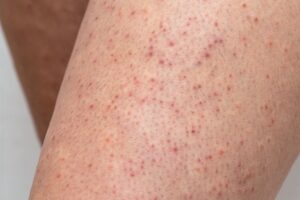
The development of lichen striatus can be thought of as a transient, benign cellular event. It is an internal, biological phenomenon and is entirely non-contagious. Identifying this streaked milestone early provides reassurance, allowing you to confidently support the skin barrier while the condition runs its natural, self-clearing course.
The Progression Profile: From Active Streak to Fading Shadow
Lichen striatus follows a very predictable lifecycle. Understanding how the skin transitions through these phases prevents unnecessary worry and helps you track your recovery.
| Condition Phase |
Key Characteristics and Appearance |
|---|---|
| Active Phase | The sudden emergence of a linear band or parallel streaks made of small (2-4mm), flat-topped bumps that can be skin-colored, pink, or tan. The surface may be smooth or develop a fine, loose scale. It is typically asymptomatic or mildly itchy. |
| Resolution Phase | The warty texture flattens out, and the active inflammation fades away. It frequently leaves behind a temporary shadow of postinflammatory hypopigmentation (pale skin), which can be particularly noticeable in individuals with darker skin tones before blending back in perfectly. |
Am I at risk for lichen striatus?
Lichen striatus occurs as an isolated, random skin reaction and is completely unrelated to personal hygiene, lifestyle choices, or a weakened immune system.
- The Pediatric Profile: This condition is strongly linked to youth, with children accounting for 50% of all documented clinical cases.
- Gender Predilection: Females are affected significantly more often than males, demonstrating a female-to-male ratio of 2:1 to 3:1.
- The Blaschko Pathway: Anyone with a genetic or environmental sensitivity can activate this response, causing the immune cells to align along embryonic skin cell boundaries.
Where and How It Appears on My Body
Lichen striatus leaves an unmistakable visual “map” on the extremities that helps your provider easily differentiate it from other types of skin rashes.
- The Limb Streak: The arms and legs are the most common hotspots by far. The condition presents as a continuous or broken linear band tracking down a single extremity.
- Anatomic Sparing: It is exceptionally uncommon for this specific condition to pop up on the trunk, head, face, or neck regions.
- The Nail Milestone: In rare instances where the linear band climbs directly through a finger or toe, it can involve the nail matrix. This can lead to temporary nail splitting, deformities, or total nail loss, which regrows as the root heals.
- Texture Check: The small papules are clustered tightly together, creating a slightly raised, sand-paper or bead-like line embedded within the skin.
Solutions I Can Try at Home
Because lichen striatus resolves spontaneously and most active treatments are not consistently effective, home care focuses on comforting the skin and supporting the barrier.
- Gentle Hydration: Apply thick, fragrance-free moisturizing creams or ointments daily to alleviate dry flaking along the line of the streak.
- Leave the Bumps Alone: Picking, rubbing, or attempting to scratch away the linear band will only cause surface damage, prolong the recovery timeline, or risk introducing a bacterial superinfection.
- Sun Awareness: Protect the area from sunburn. Sun exposure can darken the surrounding healthy skin, making the temporary pale shadow left behind during the healing phase look more prominent.
When Should I See a Dermatology Provider?
A professional diagnosis provides absolute certainty and rules out other conditions that can track along similar linear pathways.
Seek Professional Help if You Notice These “Red Flags”:
- Severe or Disruptive Itching: The normally calm streak becomes intensely itchy, causing distress or keeping a child awake at night.
- Widespread or Structural Spreading: The linear band begins spreading aggressively across the joints, trunk, or face.
- Signs of secondary complication: You notice bleeding, open sores, pus, or severe swelling along the line of the bumps.
- Diagnostic Uncertainty: The streak has a very thick, thick, warty crust that doesn’t budge, requiring evaluation to rule out conditions like an inflammatory epidermal nevus (ILVEN) or linear porokeratosis.
Frequently Asked Questions
- Q: How long does it take for lichen striatus to clear up completely?
A: Spontaneous resolution is the standard outcome for this condition. For the vast majority of patients, the linear band will flatten and fade away entirely on its own within six months to a year, requiring only patience and reassurance. - Q: How do dermatologists manage symptoms if the streak is bothersome?
A: If treatment is requested for mild itching or redness, a provider may prescribe a mild topical steroid cream or a modern, steroid-sparing topical anti-inflammatory agent (such as a calcineurin inhibitor) to help soothe the skin without risking thinning. - Q: Can a biopsy help if the diagnosis is unclear?
A: Yes. While a biopsy is rarely required because the linear visual map is so distinct, a small tissue sample can confirm the diagnosis by showing characteristic inflammatory cells wrapped around the sweat ducts and lower epidermis, effectively ruling out linear psoriasis or lichen planus.
The long-term outlook for lichen striatus is exceptional, as it is a completely benign, self-limiting event that resolves fully without threatening your general physical well-being. Success relies on maintaining a supportive skin barrier, giving the lifecycle time to complete, and letting your skin’s natural healing rhythm restore the tracking lines smoothly.
Managing Lichen Striatus is complex and involves focusing on general skin care and working with a dermatology provider to determine the best treatment plan for you.