
Quick Summary: A dermatofibroma is a common, completely benign (non-cancerous) skin growth that typically feels like a firm, hard bump under the skin. Most require no treatment beyond reassurance, but they can be surgically removed if they become painful, change in appearance, or cause cosmetic concern.
What Is Causing This Hard Bump?
Understanding how your skin heals and responds to minor irritation is a strategic first step in identifying a dermatofibroma. These growths, also known as benign fibrous histiocytomas, result from an overgrowth of cells in the deeper layer of your skin. You can think of a dermatofibroma as a “hypersensitive healing” response—often triggered by a minor, forgotten injury such as an insect bite, a thorn prick, a shaving nick, or an inflamed hair follicle.
The “So What?” factor for this condition is peace of mind. Because a dermatofibroma is an exuberant multiplication of scar tissue rather than a dangerous malignancy, knowing its unique physical characteristics helps prevent unnecessary anxiety.
Podcast:
Learn More About Dermatofibroma
The Direct Sign: The Clinical Dimple Test
Dermatofibromas have a highly reliable clinical hallmark known as the “dimple sign” (or Fitzpatrick sign) that sets them apart from other skin bumps. Knowing how to safely check for this feature helps confirm its benign nature.
| How to Perform the Test | What a Positive Result Means |
|---|---|
| Gently pinch the normal skin immediately surrounding the hard bump from the sides. | Instead of pushing upward, the firm nodule will retract inward, creating a distinct central depression or “dimple”. This occurs because the growth is physically tethered to the top layer of skin. |
Am I at risk for a dermatofibroma?
Dermatofibromas are incredibly common everyday growths. They are completely unrelated to personal hygiene, skin cleanliness, or a compromised immune system.
- Age and Gender: They can develop at any age but are most frequently observed in young to middle-aged adults, typically between 20 and 50 years old. They show a strong preference for women, occurring up to four times more frequently in females than in males.
- Minor Trauma: Anyone who frequently experiences insect bites, shaving cuts, or minor outdoor scrapes is naturally at a slightly higher risk of triggering these scar tissue nodules.
- Multiple Eruptive Lesions: While a single dermatofibroma is normal, the rapid appearance of many nodules at once is a rare phenomenon exclusively linked to underlying conditions like HIV/AIDS, Lupus (SLE), or specific immunosuppressive medications.
Where and How It Appears on My Body
Dermatofibromas leave a predictable “map” on the body, favoring specific locations and demonstrating a highly variable color profile.
- The Extremities: The lower legs are by far the most common hotspot on the body. They are also frequently found on the arms and upper back, but are exceptionally rare on the head, neck, palms, or soles.
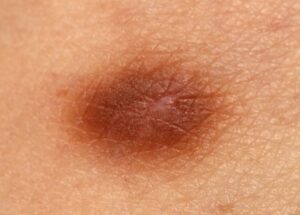
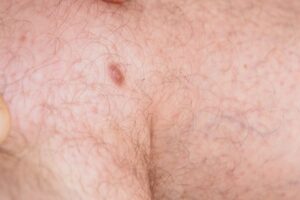
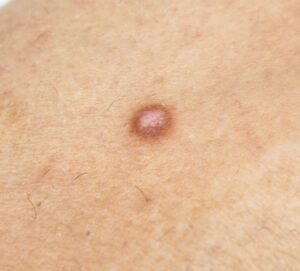
- The “Hard Pea” Texture: They typically present as a solitary, isolated bump that feels like a hard pea, button, or small stone trapped directly within the skin.
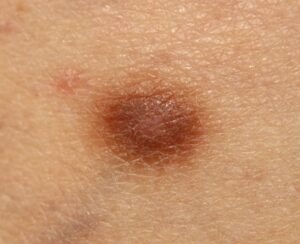
- Color Variations: The color is highly variable and can range from pink or tan to a reddish-brown or deep brown. In darker skin tones, they may appear dark brown or black.
- The Two-Tone Look: Many dermatofibromas exhibit a classic “two-tone” pattern under close inspection, featuring a dusky, dark center surrounded by a significantly paler rim.
Solutions I Can Try at Home
Because dermatofibromas are completely harmless and benign, the safest at-home approach is to leave them alone and protect the skin barrier.
- Do Not Squeeze or Pick: Dermatofibromas are fixed scar tissue underneath the skin; squeezing, picking, or trying to “pop” them will only cause painful inflammation, bleeding, or leave a darker post-inflammatory mark behind.
- Shaving Awareness: If the nodule is located on your legs or face, be careful when shaving. Since they are raised, razor blades can easily nick the surface and cause bleeding.
- Moisturize and Reassure: Keep your general skin well-hydrated to reduce any dry flaking on the surface of the bump. Rest assured that these stable nodules often remain the exact same size for decades without spreading.
When Should I See a Dermatology Provider?
A professional evaluation is important if a bump behaves aggressively, loses its classic characteristics, or causes you physical discomfort.
Seek Professional Help if You Notice These “Red Flags”:
- Rapid Growth or Pain: The nodule grows significantly larger, bleeds spontaneously, or becomes painful to the touch.
- Negative Dimple Sign: The bump does not pinch inward or dimple, which means it could be a different type of tumor—such as an epidermal inclusion cyst, a leiomyoma, or a rare aggressive growth like Dermatofibrosarcoma Protuberans (DFSP).
- Color Variation and Bleeding: The nodule develops highly irregular, shifting shades of blue-black or gray-brown, which requires a biopsy to rule out a melanoma.
- Cosmetic Obtrusiveness: The growth protrudes prominently or catches on your clothing, and you wish to discuss formal surgical excision under the skin.
Frequently Asked Questions
- Q: Will a dermatofibroma go away on its own?
A: Spontaneous regression is rare but possible. For the vast majority of patients, they are permanent fixtures that persist indefinitely without causing health issues. - Q: Can a dermatofibroma turn into skin cancer?
A: No. A true dermatofibroma is entirely benign and does not mutate into skin cancer. However, because certain rare skin cancers can mimic its appearance, a dermatologist should evaluate any new or changing hard bump. - Q: What happens if I choose to have it surgically removed?
A: Your provider will perform a surgical excision that includes the deeper fat layers to ensure complete removal. You should note that because these are highly structured dermal cells, the resulting linear surgical scar may be more noticeable than the original small nodule.
The long-term outlook for a dermatofibroma is excellent, as they are inherently non-threatening and structurally stable. Success lies in professional verification, routine skin self-exams, and knowing when to seek definitive care if a nodule changes.