
1. Introduction: What is CCCA?
In the specialized field of dermatology and trichology, Central Centrifugal Cicatricial Alopecia (CCCA) is recognized as a significant form of scarring hair loss. For patients, understanding CCCA is strategically vital: while the condition leads to the permanent destruction of hair follicles, early recognition is your most powerful tool for preserving the hair you have.
Podcast:
Learn More About Central Centrifugal Cicatrical Alopecia
Defining the Condition
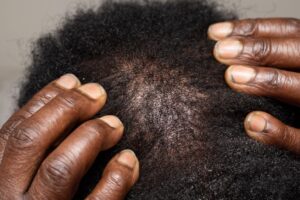
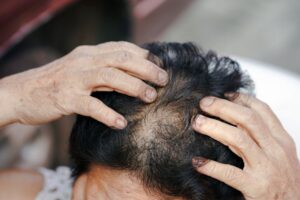
CCCA is an inflammatory condition that results in permanent hair loss. It follows a “centrifugal” pattern, meaning it begins at the vertex (the crown or top of the head) and spreads outward symmetrically, similar to the spokes of a wheel. Unlike non-scarring forms of hair loss, CCCA involves fibrosis, where healthy follicles are replaced by scar tissue.
Recognizing the Signs
Because early stages can be subtle, it is essential to monitor your scalp for these specific indicators:
- A Widening Part: The line of your natural part may appear broader or less defined.
- “Forme Fruste” (Abnormally Short Hair): You may notice hair that seems incapable of growing past a certain length or breaks easily in the crown area.
- A “Shiny” Scalp: In affected areas, the scalp may take on a smooth, reflective appearance.
- Loss of Follicular Openings: As the condition progresses, the tiny “pores” or openings where hair emerges disappear.
The “So What?” Layer: The “shiny” appearance of the scalp is a clinical sign that the follicular openings have been lost to scarring. Once a follicle is replaced by scar tissue, it can no longer produce hair. This biological reality is why catching the condition before the scalp becomes shiny is the only way to ensure hair preservation.
The Significance of Scalp Symptoms
Patients often ask if pain is a prerequisite for a diagnosis. It is not. While many experience burning, itching, or tenderness, others have a “quiet” scalp with no physical symptoms at all. It is critical to understand that the absence of pain does not mean the condition is inactive; inflammation can damage your follicles silently.
Recognizing these physical signs is the first step toward intervention, but to manage the condition effectively, we must look at the underlying biological drivers.
2. Why is This Happening? Understanding the Causes
Identifying the “why” behind CCCA is essential for managing expectations and removing the burden of self-blame. While medical science is still evolving, we now view this as a complex medical condition rather than a simple cosmetic failure.
The Search for a Cause
The exact primary cause of CCCA remains unknown, but the biological mechanism is well-documented. The condition involves chronic inflammation and premature desquamation—the early shedding—of the hair follicle’s inner root sheath. This internal structural collapse leads to the eventual scarring of the entire follicle.
The Genetic Connection
Recent research has highlighted a strong genetic component to CCCA. Studies suggest a significant familial predisposition, specifically linked to mutations in the PADI3 gene, which is responsible for enzymes essential to proper hair shaft formation.
The “So What?” Layer: If you carry a mutation in the PADI3 gene, your hair is built differently at a cellular level. This genetic insight transforms the narrative of CCCA: it is not a result of “neglect,” but a biological predisposition where your follicles are inherently more vulnerable to inflammation and structural failure.
Understanding that your biology sets the stage allows us to examine the external factors that may trigger or accelerate the condition.
3. Am I At Risk? Recognizing Key Factors
Identifying risk factors helps you understand your personal health context without the weight of guilt. For many, CCCA is the result of a “perfect storm” where genetic vulnerability meets external stressors.
Demographics and History
CCCA is most commonly diagnosed in women of African descent, typically between the ages of 30 and 60. Because of the strong genetic link, having a female relative with thinning at the crown significantly increases your clinical risk profile.
The Role of Hair Care
Historically, “traumatic hair practices” were blamed as the sole cause of CCCA. Today, we have a more nuanced clinical understanding of the impact of:
- Chemical relaxers and perms.
- Excessive heat from hot combs and blow dryers.
- Tight hairstyles such as braids, weaves, and extensions.
The “So What?” Layer: We now distinguish between these practices as “direct causes” versus “predisposing factors.” For most, these styles do not cause CCCA on their own. However, in individuals already biologically predisposed, these practices create mechanical stress and scalp irritation that worsen existing inflammation, accelerating the “active edge” of hair loss.
Other Health Links
Research is currently exploring systemic links between CCCA and other inflammatory conditions. There are potential correlations with autoimmune diseases, type 2 diabetes, and even bacterial or fungal infections. This suggests that CCCA may be one manifestation of a broader inflammatory environment in the body.
By identifying these risks, you can implement the lifestyle modifications necessary to support clinical treatment.
4. How Can I Manage This? Non-Prescription Care and Lifestyle Changes
While medical interventions such as steroids or antibiotics are necessary to stop inflammation, patient-led modifications are the foundation of a successful management plan.
Essential Hair Care: Do’s and Don’ts
To protect the “active edge” of your hair loss—the area where follicles are still alive but under attack—you must adopt a scalp-preservation regimen:
- DO minimize or entirely avoid heat styling and hot combs.
- DO choose loose, low-tension styles to avoid mechanical stress on the follicle.
- DO prioritize gentle scalp hygiene to reduce the risk of secondary irritation.
- DON’T use chemical relaxers or perms, as these can exacerbate deep-seated inflammation.
- DON’T ignore a “quiet” scalp; remember that inflammation can progress even in the absence of itching or pain.
The “So What?” Layer: These changes are designed to “calm the storm.” By removing external stressors, you reduce the inflammatory burden on the scalp. This allows clinical treatments to target the underlying biological disease more effectively, rather than just fighting the damage caused by styling.
Psychosocial Support
The emotional impact of hair loss is profound. You do not have to manage this alone.
While these home-care steps are vital, they must be paired with a professional clinical diagnosis to ensure the best possible outcome.
5. Next Steps: Seeking a Professional Diagnosis
If you suspect you are experiencing CCCA, the clinical necessity of a professional evaluation cannot be overstated.
The Diagnostic Process
A dermatologist will use clinical evaluation and often a 4mm punch biopsy to confirm the diagnosis. This involves removing a small tissue sample for microscopic examination.
The “So What?” Layer: Your doctor will purposefully take the biopsy from the “active edge” of the hair loss area rather than the center. This is because the center is often already scarred over, while the active edge is where the inflammation is most visible under a microscope. Identifying the specific type of inflammation at this edge is key to choosing the right medication.
Defining the Goal
It is important to align expectations with clinical reality:
- The Primary Goal: To stop or significantly slow the progression of hair loss.
- The Secondary Goal: To stimulate regrowth in areas where follicles have not yet been replaced by scar tissue.
- Future Options: For cases where the condition has been medically stabilized for a significant period, hair transplantation may be considered. However, patients must be aware that the survival rate of transplanted grafts is generally lower in scarred tissue than in healthy skin.
The Urgency of Early Intervention
The prognosis for CCCA is directly tied to how early treatment begins. Advanced CCCA, characterized by extensive scarring and the loss of follicular openings, has a poorer prognosis. Early clinical diagnosis remains the most critical factor in hair preservation.
Your hair health is a partnership. By combining proactive lifestyle modifications with a tailored clinical treatment plan from a specialist, you can take control of CCCA. Schedule an evaluation today to begin the journey of stabilization and preservation.