
Quick Summary: Alopecia areata is an autoimmune condition where the immune system mistakenly attacks hair follicles, leading to smooth, round patches of hair loss. It can affect the scalp, beard, or eyebrows. While the course is unpredictable, hair often regrows on its own or with medical assistance.
Why am I losing hair in round patches?
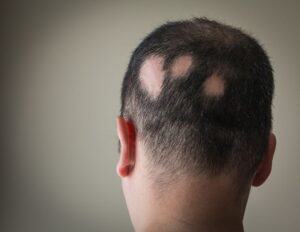
In Alopecia Areata, your body’s immune system—which is supposed to protect you—identifies your hair follicles as “foreign” and attacks them. This causes the hair to fall out in distinct, smooth circles. A key sign often seen by dermatologists is “exclamation point hairs” at the edges of these patches.

Podcast:
Learn More About Alopecia Areata
Is this type of hair loss permanent?
Fortunately, the follicles usually remain alive. This means that even if a patch is completely smooth, the “machinery” to grow hair is still there; it is simply being suppressed by the immune system.
Taking Charge: Supporting your recovery at home
- Sun Protection: Because the patches are smooth and exposed, use sunscreen or hats to protect the scalp from UV damage.
- Anti-Inflammatory Diet: While not a cure, a diet focused on whole foods and anti-inflammatory ingredients (like Omega-3s) supports overall immune health.
- Stress Reduction: Stress is a known trigger for autoimmune flares. Practices like yoga or meditation can be beneficial.
- Cosmetic Options: Many patients find confidence using scalp powders or brow pencils while waiting for regrowth.
When should I see a doctor?
Because the course of alopecia areata is unpredictable, consult a dermatology provider if:
- You notice a new, rapidly expanding patch of hair loss.
- You have multiple patches or are losing hair from eyebrows, eyelashes, or the body.
- You experience tingling, itching, or “burning” sensations (trichodynia) on the scalp.
- The hair loss is impacting your emotional well-being or confidence.
Common Patient Questions
Q: Can Alopecia Areata spread to the whole body?
A: In a small percentage of cases (1-2%), it can progress to total scalp loss (Alopecia Totalis) or total body loss (Alopecia Universalis), but for most, it remains confined to patches.
Q: Will the hair grow back white?
A: It is common for hair to initially regrow without pigment (white or blonde) before eventually returning to its natural color.