
Quick Summary: Pityriasis alba is a mild form of eczema causing pale patches, primarily in children. Management involves aggressive moisturizing and daily sun protection to help spots blend in as the skin heals naturally over time.
What Are These Pale Patches?
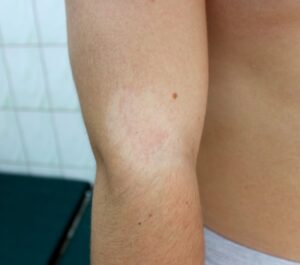
Pityriasis alba is a subtle “damaged barrier” reaction. It often starts as a faint, scaly pink area that eventually leaves behind a round or oval pale spot. It is temporary and not a permanent loss of pigment.
Podcast:
Learn More About Pityriasis Alba
Understanding the Presentation: Scaly vs. Pale
| Stage | Key Characteristics |
|---|---|
| Early Stage | Faintly pink patches with a fine, “bran-like” scale. |
| Late Stage | Smooth, pale patches. Most noticeable in summer when surrounding skin tans. |
Am I at risk for pityriasis alba?
This is an incredibly common childhood condition and a biological sensitivity of the skin’s barrier.
- Children & Teens: Most common between ages 3 and 16.
- Atopic History: History of eczema, asthma, or hay fever.
- Sun Exposure: Frequent swimming and sun exposure can highlight the patches.
Where and How It Appears on My Body
- The Face: Most common on the cheeks and chin.
- Upper Arms: Outer upper arms and shoulders.
- Hazy Borders: Patches have “soft” edges, helping distinguish them from other conditions.
Solutions I Can Try at Home
- Daily Sunscreen: Reduce the contrast between the light spots and surrounding skin.
- Aggressive Moisturizing: Treat the underlying low-grade eczema and reduce scaling.
- Gentle Hygiene: Use soap-free cleansers to avoid drying out the skin.
When Should I See a Dermatology Provider?
Seek Professional Help if You Notice These “Red Flags”:
- Pure White Spots: Patches are “snow white” rather than just pale.
- Intense Itch: Spots are causing distress or significant itching.
- Rapid Spreading: Patches spreading quickly beyond the face and arms.
Frequently Asked Questions
- Q: Is it a fungus?
A: No. It is a type of eczema and is not contagious. - Q: Will the color return?
A: Yes. Restoration can take several months, but the pigment will return.
Pityriasis alba is a self-limiting condition that resolves as children get older. Success lies in consistent skin hydration and diligent sun protection during the healing process.